
The Redress of Teaching
What Teaching is Supposed to Do

When I think about some of my favorite years in the classroom, what makes them so special is an abundance of hope and creativity. The beginning of the school year starts with excitement about meeting your new students, getting to know them individually, and eagerness to try new things in the classroom. There is an initial rush of creativity as you set up your classroom, create seating charts, and organize new school supplies. The first days of school are happily exhausting, similar to a runner’s high after a race.
As the year progresses, outside stressors accumulate: meetings, paperwork, sickness, missed lunches to cover another class, testing, more meetings, shortened planning time to make a parent phone call, mandated initiatives, teacher evaluations, more testing. Veteran teachers understand that these things just come with the job. Many of are outside of our control; we take the hits as best as we can, and continue to teach.
Experience has taught me that the more I fill my classroom with things I love: book clubs, building classroom culture, poetry recitations, music, critical thinking, flow states, deep mathematical thinking, laughter, creative learning experiences, poetry, classroom discussions, and connections, the easier it is for me to bear the drudgeries.
And so, throughout the year, the balance shifts from banalities to brightness. I’ve learned in my career how to navigate the heaviness of teaching and amplify the good. When I let the have-to’s outweigh the get-to’s, teaching is more difficult. My naturally curious and optimistic attitude slowly erodes away leaving cynicism and stagnation. Some weeks, teaching feels light and full of possibility. Other times, it feels heavy and hopeless. The countless meetings, trainings, fundraising, interruptions, and testing all make it easy to lose sight of the intended, aspirational ethos of teaching and learning.
In order that human beings bring about the most radiant conditions for themselves to inhabit, it is essential that the vision of reality which poetry offers should be transformative, more than just a printout of the given circumstances of its time and place. The poet who would be most the poet has to attempt an act of writing that outstrips the conditions even as it observes them.
From "Joy Or Night: Last Things in the Poetry of W. B. Yeats and Philip Larkin", Lecture delivered by Seamus Heaney at University College of Swansea on 18 January 1993.
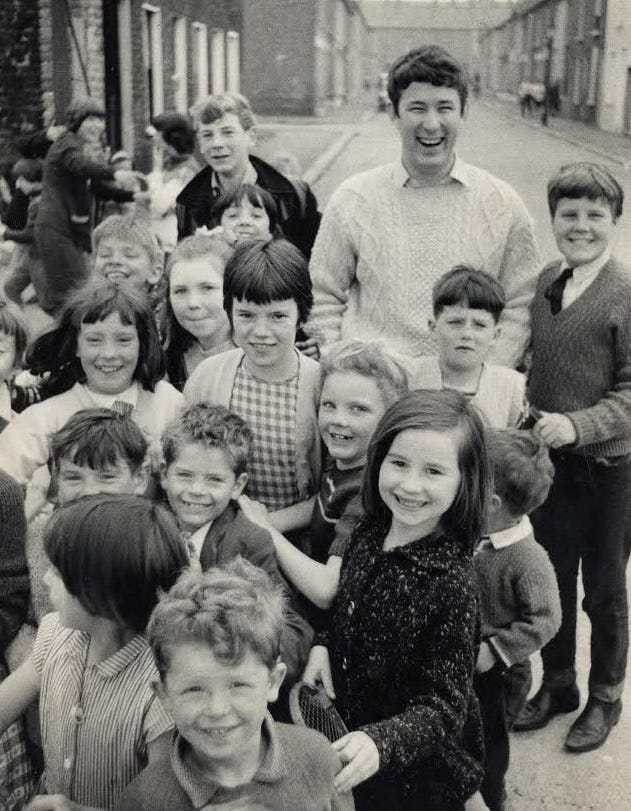
At the age of 54, renowned Irish poet, Seamus Heaney, gave a lecture at Oxford University entitled Joy or Night: Last Things in the Poetry of W. B. Yeats and Philip Larkin. Commemorating the 50th anniversary of the death of Yeats, Heaney examines how one’s fundamental attitude towards death affects one’s poetry. In comparing the poems of Yeats with Larkin, he sees a battleground emerge between how each poet writes about life and death. At the climax of his manifesto where Heaney calls for a poetry that is committed to strengthening one’s spirit, he says, “The poet who would be most the poet has to [emphasis mine] attempt an act of writing that outstrips the conditions even as it observes them.” I thought a lot about Heaney during this difficult week. Before he was celebrated as one of the 20th century’s most important poets, he was a teacher in Belfast in the 1960s at St. Thomas Secondary Intermediate School, a secondary school for Catholic boys.1 In those early days, his students were deprived and disaffected middle-class adolescent boys living through a tumultuous political conflict. Heaney was charged with teaching the boys poetry. Many of his students, “excluded by their social and cultural background from any contact with literary verse and disposed to regard it as some kind of fancy affectation” were immediately resistant to the idea of reading and analyzing poetry. This sounds like the plot of a made-for-TV movie about a charismatic, energetic English teacher (think John Keating or Frank McCourt) who works with unruly students and, through resilience and masterful teaching, inspires his class to appreciate the power of poetry.
As public educators, we all know that teaching is both an impossible job and a rewarding profession. But when I imagine Heaney in front of his adolescent students, I believe that it is these early experiences that inform his beliefs of poetry and the role of the poet. What is the good of poetry? How can it contribute to society? Is it worth the dedication it demands? Poetry must offer human beings a transformative experience so that they can be the most radiant versions of themselves. A famous line from W.H. Auden’s poem In Memory of W.B. Yeats, “Poetry makes nothing happen”, suggests to some that we should reject these romantic ideals of the power of poetry. For me, I agree more with Matthew Zapruder than poetry cynics.
I don’t know what Auden intended in that line. It’s from his elegy to Yeats. I have the intuition that he was making not a negative but a positive statement about what poetry does, which is to take the elusive and unnameable feelings and experiences that make up the vast majority of our lives and put them into words, so we can find commonality. Nothing in this case is what we otherwise would never see. It’s very easy to sound cheesy or addled if you say poetry can save us. It’s much more effective to write or read a poem to someone and have them feel it for themselves.2
30 years later, in The Redress of Poetry, Heaney argues that poetry's power lies in its ability to be both a self-sufficient art form and a counterbalance to the pressures of reality. He explores how poetry offers a "redress"—a balancing out—of the political and social imbalances of the world by providing a truthful and imaginative alternative. I have always felt that designing meaningful learning experiences for students, amid systemic pressures to conform and standardize, is what makes teaching as powerful as poetry. Unfortunately, this is becoming harder to do. Instead of liberating my students’ spirits, engaging them in the beauty of mathematics, the joy of literature, and the importance of understanding history, I am feeling overwhelming stagnation. It is hard to give my students an imaginative alternative to textbooks and worksheets, and the drilling of isolated skills when in one week, we have another school shooting, an assassination of an extremist, and the anniversary of the 9/11 attacks. It’s much easier to give students worksheets and have them ignore what is happening in the world outside of the classroom. “Read this passage and answer these questions” instead of “How are you showing up for school today? How are you feeling?”
This is the battleground I find myself facing. I fear sounding melodramatic, but I think I am mourning the slow death of what I believe is the true nature of teaching and learning. If Heaney believes that poetry is a redress of the imbalances of the world, what then is an adequate redress to the current state of teaching in 2025? How can I counterbalance the daily pressures the way poetry does for Heaney?
Family Meetings
I can’t control what happens outside of my classroom. There will probably be more school shootings and political violence. There will be protests and vitriolic social media posts, and I can’t control what my students see or hear when they leave after the bell rings. But what I can control, is how I hold space for whatever my students bring with them after the morning bell. Every morning, for the first 30 minutes of the day, I sit my students in a circle on the floor in the rear of my classroom, and we have a Family Meeting. The word family is intentional. My students are not meaningless data points to raise. I am not a task-master. I treat my students as members of our classroom family; I’m a compassionate teacher, not an authoritarian autocrat.
The school administration’s expectation is that I follow a standardized social-emotional (SEL) curriculum, keeping in lockstep with my colleagues. However, after reading Matthew Kay’s books Not Light, but Fire and We’re Gonna Keep On Talking, I am convinced that creating a classroom ecosystem of trust while helping my students practice interpersonal skills and structured discourse, is my best thing I can do for supporting their most radiant versions of themselves. Real talk; not SMART goals.
This week, especially, I was very grateful for our Family Meetings. I haven’t directly addressed 9/11 in my classroom in over a decade. To my fifth-graders, 9/11 is akin to Kennedy’s assassination. School shootings have become so commonplace, that our active shooter drills are rote movements. However, when we sat down on Thursday for our Family Meeting, I was appreciative for the work I’ve done to create a safe conversational space for my students, teaching them to listen patiently, listen actively, and police their voices. My students came to school that day with heavy feelings and the only appropriate thing to do was to hold space for them. While not my first sensitive classroom discussion, I was proud that my students are learning to have respective dialogue with each other, even when they are scared or anxious or confused.
Our daily Family Meetings are an important way to begin our day. The time we spend in community is time well spent. Holding space for students to share good news or hard things, allows them to feel that our classroom is a place that centers our collective humanity. And then afterwards, we can get back to the work of teaching and learning, knowing that we value each other more than our academic achievement.
Dialogic Teaching
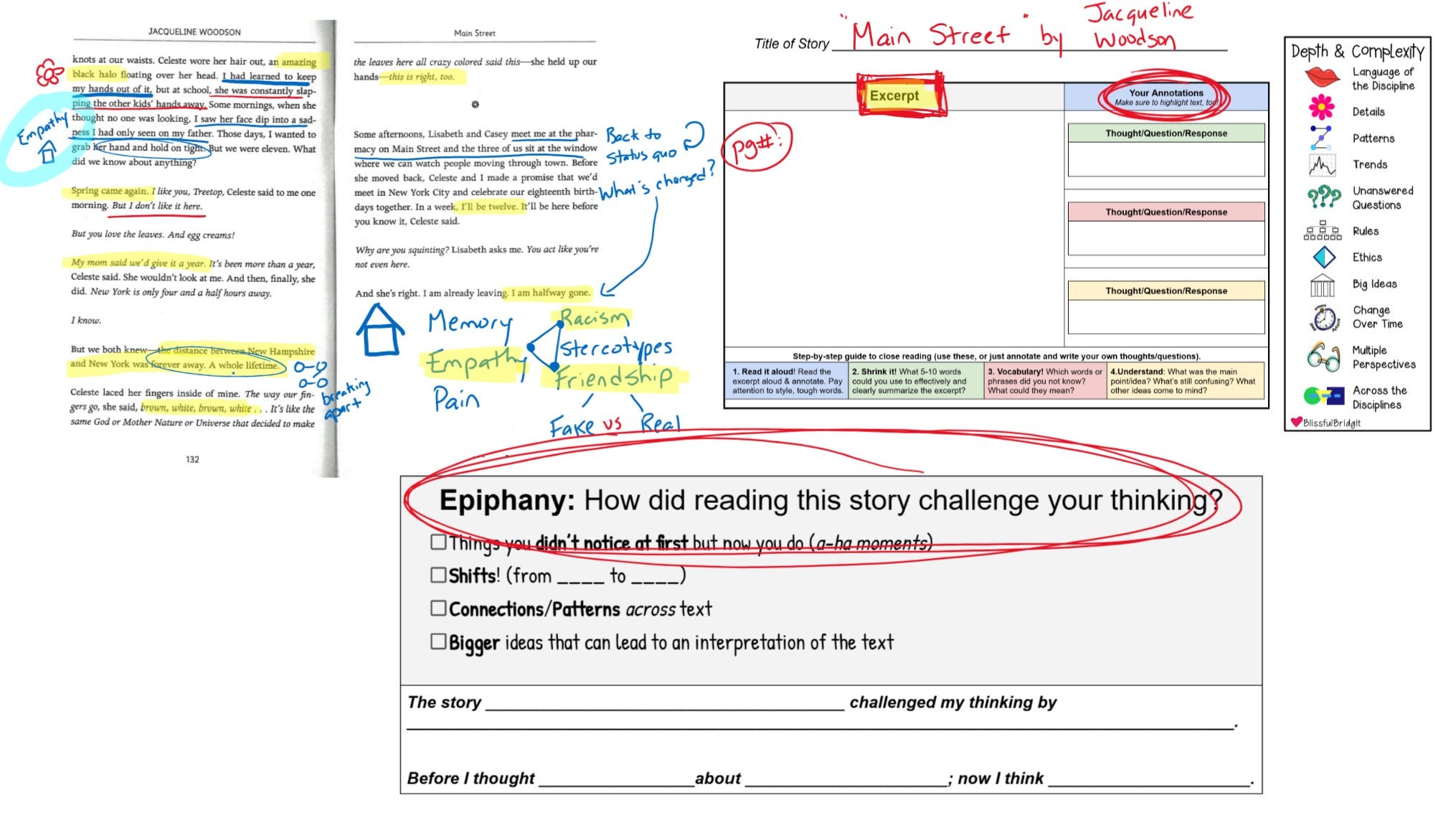
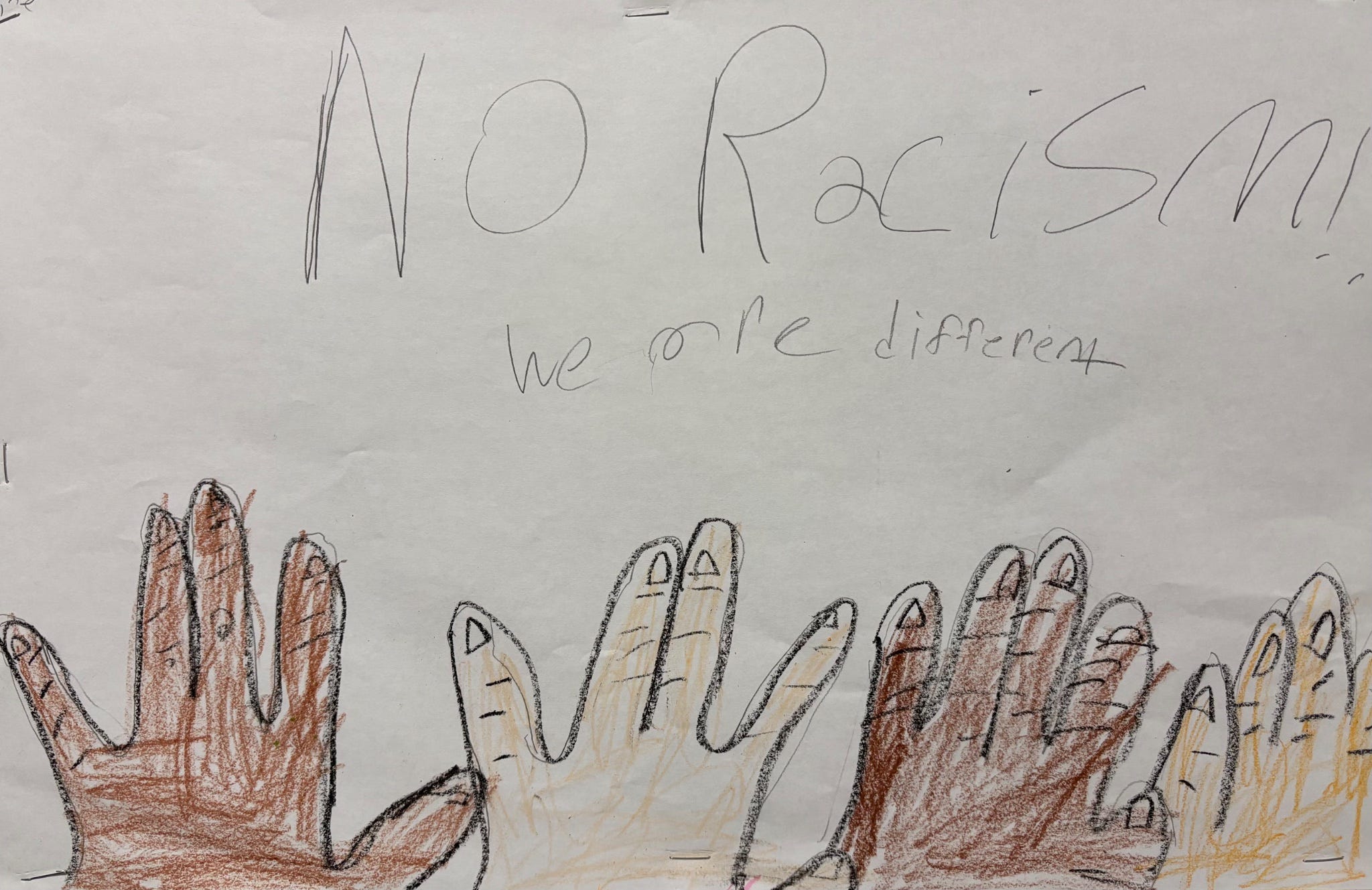
We also spent this week reading, annotating, and discussing Jacqueline Woodson’s incredible short story, Main Street. My students astounded me with their collective thoughts, questions, and epiphanies using Depth and Complexity icons. The culminating classroom discussion about empathy, racism, pain, stereotypes, and friendship proves to me that dialogic teaching is helping to restore the humanity that’s been lost in the name of standardized instruction and testing. Teaching my students how to have academic conversations about literature is my attempt to outstrip these challenging teaching conditions, while I’m experiencing them in real time. Hearing my students’ voices is a redress to the heaviness I felt this week.
Subtraction
Dialogic teaching and Family Meetings take time; time allotted to cover the curriculum. However, when I feel such a strong imbalance, where the pressures of reality, both inside and outside of the classroom, make teaching and learning too heavy, my instinct is to subtract. Quality over quantity. In our school district, we are currently prioritizing content standards so that teachers know which concepts are most important to drill for the upcoming standardized test. This means that we are at liberty to not teach it all; skipping unessential lessons that are labeled “nice-to-know.” Still, there is too much “essential” content to teach in any given school year, so it is easy to fall behind the pace of others. There is nothing transformative about teaching the same way on the same day as my colleagues. I am not looking to give my students “just a printout of the given circumstances” so that we can simply move onto the next standard. When teaching and learning feel heavy, I thoughtfully subtract instead of pile on. The time spent discussing students’ epiphanies of Jacqueline Woodson’s Main Street is worth much more than identical Tier-1 instruction for a 15-Day Challenge.3
Finders and Keepers
In Finders Keepers: Selected Prose, 1971-2001, Heaney described his essays as
testimonies to the fact that poets themselves are finders and keepers, that their vocation is to look after art and life by being discoverers and custodians of the unlooked for.4
Just as Heany argues that poetry provided a truthful and imaginative alternative to the heaviness of the world, he also emphasizes that poetry should maintain its inherent inventiveness and joy in language. So, too, should teaching fight for and maintain its inherent joy. Teaching is supposed to leverage learning mechanisms of curiosity, sociality, emotion, authenticity, and failure. I teach my fifth-graders that there is inherent value in the knowledge they build, the understanding they achieve, and the human interactions between me and them that help facilitate their personal and academic growth. None of this should happen in a vacuum absent of inventiveness and joy. When life feels heavier than usual, it is my job to help students shoulder their burdens as best as they can; sometimes with joy and laughter, or love and compassion. As a teacher, it is my vocation to be a protector of the humanities, discovering the best ways to reach and teach my students. I am a custodian for their academic well-beings. I find ways to infuse humanity into my teaching and their learning; I keep our community sacrosanct. I admit, this is more challenging today than it was 20 years ago. So much of what is wearing me down is the constant pressure to standardize my instruction. Every meeting or professional development I attend, demands I conform. But even as the constraints increase, I find small ways to stay present for my students.
John Carey, chief book reviewer for The London Sunday Times for over 40 years, once described that Seamus Heaney had a “thirty-year struggle with the demon of doubt.” We all carry demons with us; some question our motives, others lambast our actions. As a teacher, my questions of doubt are similar. Teaching is supposed to guide students to their fullest potentials. During challenging weeks, I struggle to resist the pressures and demands. If everything is standardized, what is point of the teacher? How can teaching contribute to the betterment of society if following rigid pacing guides is valued more than my individual students? With the ever-increasing constraints, is teaching still worth the dedication it demands?
I return to Heaney’s quote, The poet who would be most the poet has to attempt an act of writing that outstrips the conditions even as it observes them. He describes a paradox where a great poet must be simultaneously grounded in reality and transcend it. This poet must observe the conditions of reality and outstrip it to re-imagine and transform it. This, Heany argues, is how great poets create "fully realized poetry."
If I am to be the most teacher, I must teach in ways that protest the restrictions I face, while protecting my students (and my own) humanity. I can’t ignore the systemic pressures to conform, raise test scores, and teach out of textbooks, but I can find new possibilities within and through them. This is what teaching is supposed to do.
Have a great week!
— Adrian
Resources
Creating an Emotionally Healthy Classroom Environment
This edutopia article offers simple and concrete ways to create a safe and emotionally healthy classroom for your students.
Navigating teacher anxiety when you’re drowning in work
Author and podcaster, Angela Watson, has an incredible podcast called, Truth For Teachers. The above episode is about feeling overwhelmed as a teacher. If you would like to explore more of her episodes, she has curated episodes by topic, including The Greatest Hits, The Encouragement, and The Student Engagement Playlists.
How To Be More Present | Headspace
I started meditating with my students when I returned to the classroom after the pandemic. Having a mindfulness practice has helped me immensely to handle the pressures of teaching in a public school classroom. Headspace offers free access to K-12 teachers and supporting staff in the US, UK, Canada, and Australia.
If you are unfamiliar with Dialogic Teaching, the above video offers a great example of what it looks like to have better classroom conversations.
I could listen to Seamus Heaney discuss anything! This interview is wonderful, and I feel a lot of connection to teachers feeling heard versus part of the herd.
In this interview at The New Yorker Festival, Heaney remembers how poetry was taught in school when he was younger, discusses hope and history and talks about one of my favorite poems, The Tyger by William Blake.
I love listening to poets talk about and read their work. If you are unfamiliar with Auden’s poetry, you can start by listening to him read a selection of his poems, including Journey to Iceland, As I Walked Out One Evening, and There Will Be No Peace. The above video is Auden reading In Memory of W.B. Yeats.
Lavan, R. (2021). Education. In G. Higgins (Ed.), Seamus Heaney in Context (pp. 241–251). chapter, Cambridge: Cambridge University Press.
This is not to say that I do not provide my students with high-quality Tier 1 direct instruction and differentiated Tier 2 support. I do so in a way that supports their humanity. If one of my students is scared of a shooting happening at school, I must not ignore this to push them to complete a worksheet decode a text. To paraphrase Nel Noddings, I emphasize teaching the child over the curriculum.
May you have a lovely family meeting today 🥰
Thank you for being a dedicated teacher.