
Grasping at Straws
Fighting #CleartheList Fever

About six weeks before school starts, I become a wastrel. It can start as early as July 1, but I try to resist the temptation to log in to Twitter/X to beg for school supplies as long as possible. #CleartheList started in 2019 when then teacher, Courtney Jones, posted her Amazon wishlist on Twitter asking friends and family for help buying classroom school supplies that she could not afford herself. The post went viral, growing into a global campaign involving celebrities like Chip Gaines, Kristen Bell, Lance Bass, and Jessica Alba. Corporations like Clorox®, Post-It, and Crayola began holding contests to donate money to classroom teachers, helping them #CleartheList.
Teachers crowdsourcing supplies for their classroom is not a new phenomenon. In 2000, Charles Best, a Bronx high school history teacher, created DonorsChoose, a platform enabling teachers to request resources for their classrooms. Teachers detail classroom projects that individual donors can choose to donate to or fully fund. Best was featured on Oprah and Stephen Colbert promoted DonorsChoose on The Late Show.1 By the time #CleartheList started, The Bill & Melinda Gates Foundation and Google had both matched the donations of 69,356 donors in a single day, making it the largest day of giving in DonorsChoose history. Teachers became adept at asking for school supplies, books, and resources for their students. Social media accounts were plastered with pictures and videos of decorated classrooms and smiling teachers with the hashtags #CleartheList, #AdoptATeacher, and #TeacherWishlist2. Critics lambasted teachers for soliciting donations for classroom decor and items deemed nonessential like neon signs and karaoke machines. Scam profiles polluted Twitter and TikTok with requests for personal items like espresso machines and gift cards.
Classrooms continue to be under-resourced. Teachers are still underpaid. This is a systemic problem. On average, teachers spend between $500-$800 of their own money for supplies; many of these teachers work in Title I schools and live in economically disadvantaged communities. It is common that teachers provide students with snacks and for schools to have food pantries for the community. School districts discourage teachers from posting their wishlists on social media because of negative publicity. Districts cannot adequately supply their teachers and teachers cannot ask for help.
For me, the worst part is how crowdfunding affects my brain. Scrolling social media through the innumerable requests for supplies, I see pictures of Amazon boxes and piles of supplies with the captions, Thanks to whoever cleared my list! or Look what arrived today! DonorsChoose claims about 73% of all classroom projects on their platform are fully funded each year. Since #CleartheList is run by tens of thousands of teachers, hundreds of organizations, and dozens of influencers, there is no official, aggregate percentage for how many requests are funded. Teachers post and repost their wishlists and register them with Get Your Teach On and people like Alane Adams or John Legere, all in a desperate attempt to get their lists shopped before fall.
One-Armed Bandit Fever
It is challenging not to succumb to #CleartheList fever. Social media is built on comparison culture and FOMO. Psychologists call this the availability heuristic. It is a bias that occurs in our brain while scrolling the social media, checking our email, and gambling. We use immediate information that appears to make decisions about the future. When I see teachers thanking anonymous donors for clearing their lists, and celebrities thanking teachers for sending them their wishlists or giving them $25,000, I cannot help but feel like it could also happen to me. I cannot win if I do not play.
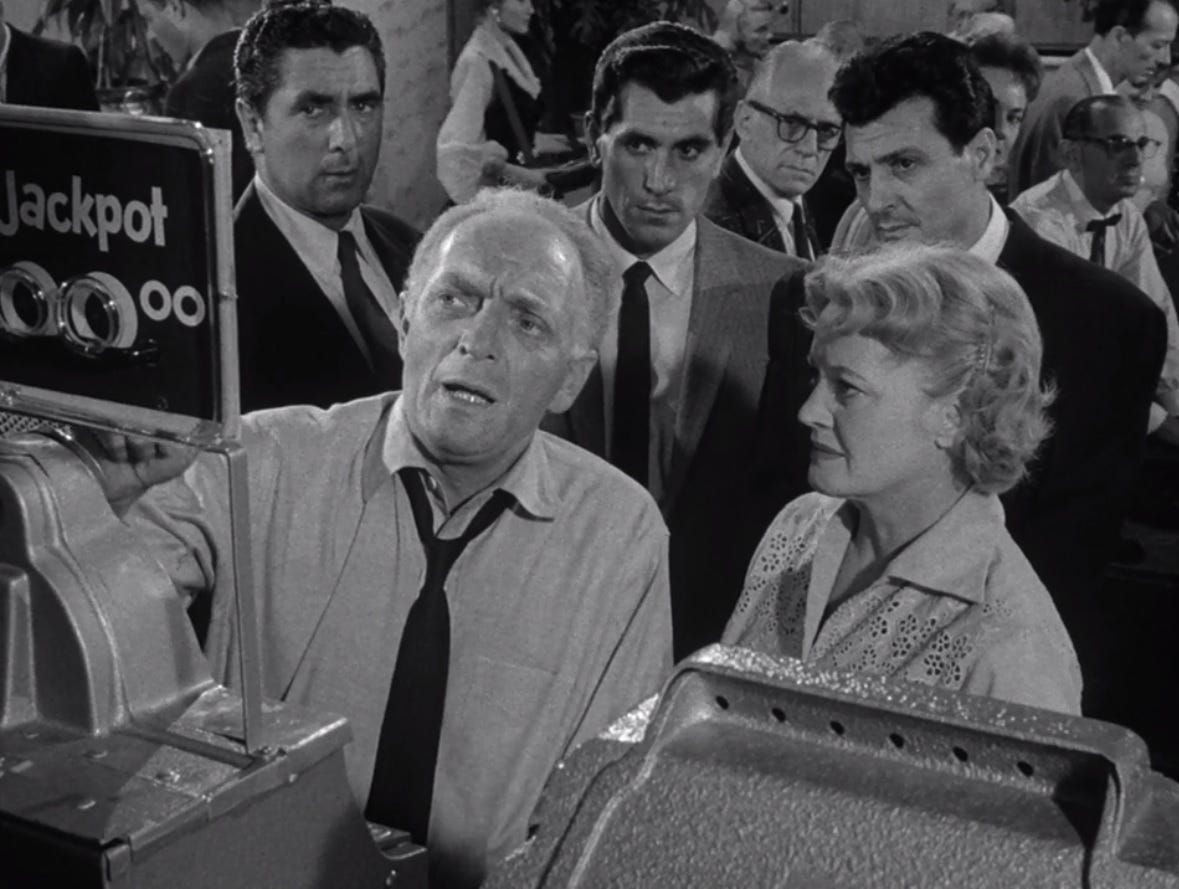
In the Twilight Zone episode, The Fever, a grumpy, conservative, tight-fisted husband named Franklin Gibbs, travels to Las Vegas with his wife. He is determined to spend their vacation avoiding gambling, while his wife, Flora, is excited because she won the vacation. Franklin is incessant about the immorality and wastefulness of gambling. By happenstance, he is tempted (forced) by a drunken stranger with a silver dollar to play a slot machine. When he pulls the lever, he is surprised to win some money. He tries to feed the money back into the machine, but ends the episode trapped on the casino floor, exhausted. The one-armed bandit torments him, forever calling his name from outside his hotel room door. It is a clear cautionary tale about gambling addiction.
The slot machine was invented in the 1890s by Charles August Fey, a German mechanic, based in San Francisco. He created a machine with three spinning reels consisting of five symbols: horseshoes, diamonds, spades, hearts, and the Liberty Bell. He attached a lever to the side so players could pull for a lucky spin. By having an automatic payout feature (releasing a maximum of ten nickels for a row of three bells), gamblers were quick to continuous playing. In the 1930s, bank robbers John Dillinger and Charles “Pretty Boy” Floyd, called slot machines “one-armed bandits” joking that they could steal your money without a gun. Even though the odds of winning are low, the availability heuristic convinces you a win is near; inevitable if you keep playing.
In the weeks prior to school starting, I catch a teacher version of one-armed bandit fever. I dust off my Twitter/X account and obsessively post my wishlist. Checking is the worst part. I check to see if anyone reposts my wishlist. I check to see if anyone gifts me something from my list. I check to see if Amazon boxes arrive on my doorstep. In between the checking, I keep posting and reposting, hoping, wishing that someone will buy supplies I cannot afford to buy myself. I waste a lot of time.
A man in peril of drowning catchest whatsoever cometh next to hand… be it never so simple a stick or straw.
Sir Thomas More, Dialogue of Comfort Against Tribulation (1534)
#CleartheList fever damages teachers’ psyche. It forces us to feel anxious and inadequate before school starts. I admit, teachers are overwhelmed and this grasping-at-straws feeling can begin before the first day of school. There is too much to do and never enough time, so teachers spend the remaining weeks of their summer break arranging their classrooms. Once teachers “officially” start, the workload explodes with thousands of tasks to complete before students arrive. Add to this, walking into a classroom with damaged furniture, dingy walls, and no storage, anxiety and stress begin to flare. Teachers use social media to beg for supplies, sharing pictures of themselves and their classrooms, telling stories, posting GIFs, hoping that someone will offer patronage. Among the tens of thousands of #CleartheList requests, some teachers post pictures of their Pinterest-perfect, aesthetic classrooms, thanking the anonymous donor(s) who funded everything. As teacher, Tom Rademacher says,
The pressure to present an Instagram-ready classroom for Open House is strong, and notable for being only the first unrealistic expectation put on teachers every year. And like many of those unrealistic expectations, there’s often a lot of work required for something that doesn’t make it easier to do our job well.
In my feverish frenzy, I keep posting and reposting on Twitter/X and TikTok. I keep checking my Amazon wishlist to see if anything has been purchased, and get excited whenever I see a delivery driver approach my front porch. It is unhealthy behavior. In my prefrontal cortex, I understand that the stuff does not matter. Teaching is not about the stuff, it is about the students. But whenever someone reposts my post, dopamine floods my brain; I get sucked into a habit loop with variable rewards. The one-armed bandit hijacks my freewill and perpetual surprise keeps my brain hooked. There are no stopping cues, just irresistible, infinite posting, scrolling, and hoping.

The good news is that once school starts, my own fever breaks and I resume more acceptable social media activity. I no longer pay attention to what I do not have. If there are certain essential items that I still need, I ask parents to donate. Or I do without. Honestly, I can steal a stapler and pencil sharpener from the supply closet; I can borrow a vacuum cleaner from the custodian. I can make do with broken stools and mini blinds. I adapt and move on. Teachers are master pivoters. Once students arrive, it does not matter how my classroom is decorated. Are there tools that might make teaching easier? Perhaps. But, I am too busy to notice because in the end, all that matters is meeting and connecting with my students and their families. I get to spend an entire school year working with them, helping them grow.
I wish our country better supported public education, that society subsidized classrooms and championed teachers everywhere. Teachers should not have to worry about whether they will have enough school supplies or books for their students. Students should not go to school hungry because they do not have enough food at home. Schools should not be required to solve all of society’s problems. And yet, every year I see the same systemic issues: poor teacher pay, food insecurity, lack of adequate resources for teachers and students. In truth, I am excited about the start of another school year. I am eager to meet my new students and learn all about them. These struggles operate in the background and are outside of my control. I can control what my classroom looks like, but honestly, that is not what is most important. I would rather have my classroom feel safe and inclusive than stylized and decorative. Will I spend a few days over the summer cleaning, organizing, and setting up my new mobile classroom? Yes. Will I obsess over minute aesthetic details? Probably.
The best way for me to resist #CleartheList fever (or feelings of inadequacy) is focusing on important intangibles: psychological safety, curiosity, empathy, respect, and belonging. What will each of these look like in my classroom this year? How will I build psychological safety? How can I structure learning experiences so that students feel belonging? How will I encourage creativity? How will I model empathy and respect? The answer to these questions does not exist on any wishlist. There is no tool or cute bulletin board that prepares me to reflect on the intangible aspects of teaching and learning. Each new batch of students presents unique challenges, and while I have expertise building psychological safety and modeling empathy, every year, I tweak how I build belonging in our classroom community because different students require different pedagogy.
To teach in a manner that respects and cares for the souls of our students is essential if we are to provide the necessary conditions where learning can most deeply and intimately begin.
bell hook, Teaching to Transgress: Education as the Practice of Freedom
I return to school in two weeks; students arrive in three. My classroom is still a mess. Unpacked boxes litter the floor. Fixing up this mobile classroom is more work than I anticipated, but I know the room will be ready to welcome students. The room is not perfect with dirty walls and broken light fixtures, but it does not need to be. In fact, no classroom will ever be perfect. My goal is to ensure my new classroom is functional and welcoming. I may not have beautiful bulletin boards or themed borders, but my classroom will be an exciting place where students feel seen, heard, and human.
Have a great week!
— Adrian
Resources
Curious about DonorsChoose.org? This short documentary explores the origins of the organization through the vignette of a middle school in the South Bronx. A couple of years later, DonorsChoose put out this even shorter documentary (micro-documentary?) about the organization’s start.
I cannot hear “one-arm bandit fever” without thinking of Dire Straits’ Tunnel of Love. In an interview, Mark Knopfler said the song’s protagonist was “his kind of guy. A risk taker. A guy who says stuff like ‘but it’s the life that I choose,’ and ‘I don’t know where I’ll be tonight.’” This is one of my favorite Dire Straits’ songs!
Susie Wise, adjunct professor at the Hasso Plattner Institute of Design (the d.school), shares activities and frameworks that actively foster belonging in the workplace, classrooms and more. This is a great conversation between Susie and Victor Cary of the National Equity Project.
Design for Belonging | Susie Wise
I read Design for Belonging by Susie Wise in one sitting. I reference it multiple times during the school year to design moments of belonging for my students. My favorite exercises are Listen for It and Picture Grid Conversations. If you are interested in trying out an activity from the book, you can test out design methods and mindsets from the Educators' Guide. These are designed for classroom use. Download Educators' Guide here.

This piece, written by veteran teacher, Jennifer of The Real Classroom is exactly what you should read before school begins this fall. I so appreciate her advice! It does not matter that I have taught for 25 years, I plan to revisit this list throughout the new (and future) school year(s).
Before You Decorate Your Classroom, Here’s a Better Idea by Tom Rademacher | Cult of Pedagogy
I first read Tom Rademacher’s Cult of Pedagogy article last summer. It inspired me to create my own One Word bulletin board. It was a huge success, both in building community and decorating my bulletin board. I plan to do this activity again. Here are resources I shared last summer for the first week of school.
Good Teaching Is Not Just About the Right Practices by Sarah Gonser | Edutopia
This Edutopia article is six years old, but still full of wisdom. Inspired by The Atlantic’s On Teaching series (another piece I highly recommend), Sarah Gonser interviews a variety of veteran teachers asking, What makes a good teacher?
For a more meaningful life, start here | Dr. Arthur Brooks
I stumbled onto Dr. Brooks’ latest book, The Meaning of Your Life at the beginning of summer. I listened to him chat with Simon Sinek as I reflected on my annual em dash pause. Then, I found the above video where Dr. Brooks discusses three things one should do for a more meaningful life. Here is Dr. Brooks on the Today show discussing actionable steps to take, including the three key questions you should be asking yourself. After my #CleartheList fever, his book is proving to be just the thing I need to read and rebalance myself this fall.
Stephen Colbert is a DonorsChoose Board member.
#CleartheList has since migrated to multiple social media platforms like Instagram, TikTok, Facebook, and Pinterest.
“About six weeks before school starts, I become a wastrel.” What an opener! 😂
Classroom setup shouldn’t be underestimated—either in terms of the effort it takes or the impact it has. It’s the place we show up every day, and it matters that we feel safe, regulated, organized, and at home there. I really appreciated this reflection!
Great article. I tried the #ClearTheList “lottery” as you describe for a couple of years, and received nothing. There are teachers who regularly get their lists cleared by parents at my school - either young and cute teaching TK through first grade, or anyone teaching 5th grade. At this point my list is just a reminder to myself of what I would like in my classroom, and I purchase the items myself.
As far as DonorsChoose, our district has very specific rules about what we are and aren’t allowed to ask for, and everything must be pre-approved by the site principal.