
Highly Effective
Reality versus Ratings

In June 2013, the state of Colorado updated their teacher evaluation system based on Senate Bill 10-191. Many teachers were upset because under the new guidelines, 50% of a teacher’s rating would come from students’ standardized test scores. For the other half, teachers would receive a score on six Quality Standards such as professionalism, reflecting on one’s practice, and establishing a safe, inclusive learning environment.
Beginning in 2023, based on a change to state law, the Professional Practice Standards (#1-4) are now worth 70% of a teacher’s final summative evaluation. The measures of student learning standard (#5) is worth 30% of an teacher’s overall evaluation rating.1
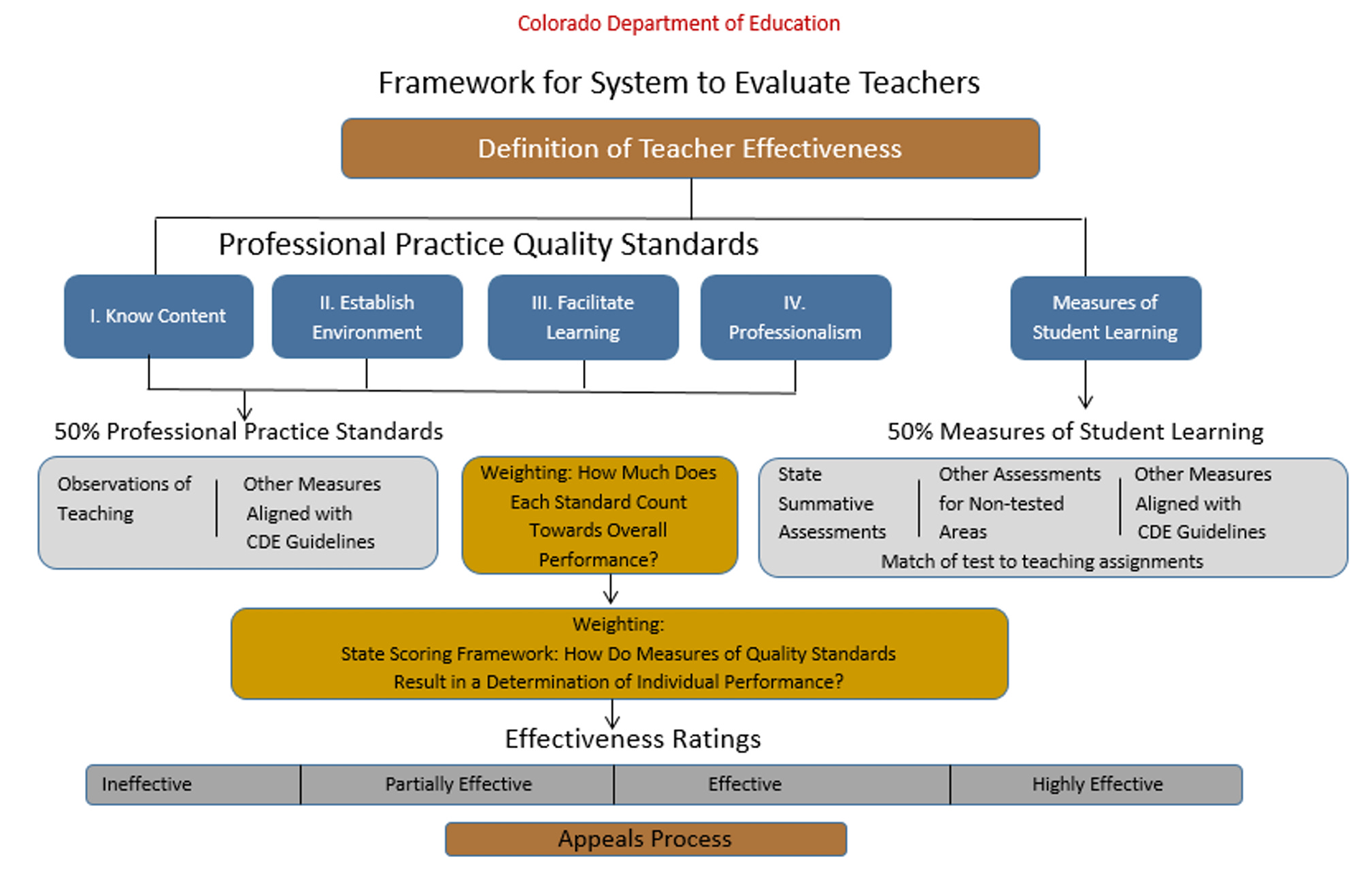
While this did ease worries about teachers’ final evaluations relying so heavily on how students perform on standardized tests, student learning, based on quantitative metrics are still part of how districts and states measure a teacher’s effectiveness.
At the beginning of each school year, I complete my self-evaluation on the six Quality Standards. At the end of the year, in order to be considered an “Highly Effective Teacher”, I must score 5’s on each of the Quality Standards’ Elements.2 Depending on what my administrator observes throughout the year, and what I discuss during my final evaluation meeting, how I view myself as a teacher often differs my principal’s.
I have written before about my frenemy relationship to student data. Even though standardized tests were designed to measure student growth and hold teachers accountable for that growth, in the last two decades, they have been used to unfairly evaluate teachers, and in some extreme cases, been weaponized against teachers.3
Come May, I find myself studying my evaluation and asking, does this accurately represent my effectiveness? As a younger teacher, I often got tangled trying to justify a few more points on my evaluation so that I would be labeled effective instead of partially effective. I remember sitting in meetings asking for concrete examples of the different levels for each of the Quality Standards. Every once in a while, I would successfully argue for a slightly higher rating, but over the years, that seems like a lot of work for an inconsequential label. I would never want to be considered an ineffective teacher, but what is the difference between Partially Effective, Effective, and Highly Effective? Are these dramatically different teachers? Are students learning more from a Highly Effective teacher than a mere Effective one?
I’ve learned that in order to be a Highly Effective teacher in Colorado, not only must I be able to demonstrate mastery in each of the Quality Standards, my students must be able to do so, too. For example, under Quality Standard 1: Pedagogy, a highly effective teacher shows that they are an expert in the content they teach and has students who provide relevant connections to academic standards in their own words. An effective teacher can demonstrate their knowledge of content, central concepts, inquiry, appropriate evidence-based instructional practices, and specialized characteristics of the disciplines being taught. A highly effective teacher can do this and has students who can generate questions that lead to further inquiry and self-directed learning, while synthesizing concepts to create original thinking within and across disciplines.
I believe all teachers want to be effective. It can be challenging to prove one’s effectiveness from year to year depending on the students who are assigned to you. So much of teaching is outside my circle of control. Even though I believe in my core that all students have the ability to learn at high levels, given opportunities, love, and time, I can’t control whether they ate breakfast that morning or got a good night’s sleep. I can create opportunities for my students to be successful, but I can’t force them to take advantage of those opportunities. Some years, I receive more challenging students. Many times, the students who end up in my classroom have experienced some form of curriculum and school trauma, making it almost impossible for them to feel safe enough to learn and grow. Do I wish the system didn’t do this to students? Absolutely! Do I lower my standards and give up? Never! I teach the students I have.
Then, at the end of the year, I look at my evaluation and wonder if my students had scored higher on their standardized tests or didn’t get into as many fist fights in the back of the classroom, would I be seen as a more effective teacher? Was I less effective because I spent more time caring for my students’ social and emotional well-being instead of teaching?
The reality is that expert teaching requires approaches that are responsive, inclusive, adaptive, challenging, and compassionate. Some days are more challenging than others, but no matter which students are sitting in my classroom, focusing on a single metric like test scores fails to recognize my students’ full individuality and humanity, and fails to acknowledge the dynamic aspects of being an individual teacher. When I receive scores of Partially Effective, I think about what I could have done to be more effective for my students, and whether those things are even observable to evaluators.
I’m reminded of a scene from The Shawshank Redemption. Red, played by Morgan Freeman, is up for parole. He has been denied parole twice before. Each time, he tries to convince them he's a changed man, but the board's skepticism leads to rejection. On his third attempt, he speaks honestly about his regret of the crime he committed.
There's not a day goes by I don't feel regret. Not because I'm in here, or because you think I should. I look back on the way I was then: a young, stupid kid who committed that terrible crime. I want to talk to him. I want to try and talk some sense to him, tell him the way things are. But I can't. That kid's long gone and this old man is all that's left. I got to live with that. Rehabilitated? It's just a bullshit word. So you go on and stamp your form, sonny, and stop wasting my time. Because to tell you the truth, I don't give a shit.
The more I have cared about the degree of my effectiveness as a teacher, the lower my evaluation scores. The more I worry about raising my students’ test scores by teaching to the test, the more I feel like I’m less effective as a teacher. Whenever I’ve staged a lesson just for observation, my teaching feels flat and I leave feeling empty. If I try to get my students to act a certain way in order to demonstrate my own effectiveness, that isn’t teaching. Effective? I know what they think it means. After 23 years in the classroom, I’m starting to believe it’s a made up word used to sort teachers, distinguishing between what legislators believe are strong and weak teachers. There is no way to objectively observe a bustling classroom of students. Evaluators bring their bias and see what they want to see and mark down what they feel they should. I appear to be a more effective teacher if I’m lecturing to a classroom full of compliant white students who sit quietly and hang on my every word, writing diligently in their notebooks. When I’m having a conversation with students in the back of the classroom about something that is not related to the prescribed lesson, I’m seen as less effective. Evaluators see that I’m not maximizing my instruction time as per the curriculum. What isn’t seen is how connecting with those students helps them feel more valued as human beings, which slowly inches them toward feeling like a learner.
Evaluators have an impossible job. They get 30 minutes to observe a teacher, and then must rate that teacher on a very detailed set of expectations. Obviously, the more they watch their teachers teach, the better informed they are with their overall scoring. Unfortunately, administrators are as overworked as teachers. Many want to spend more time in classrooms, getting to know their teachers and students, but they can’t.
The reality is messier than the rating. You can’t quantify a teacher’s effectiveness in a single number. Those early years when I based my success on my teacher evaluation, I lost sight of what matters: my students’ growth; my own growth; and the growth of our classroom community. I know that I have areas of growth as a teacher. I could be more structured in my classroom and more diligent in keeping students on task. Those things are easier to observe, but come with their own biases. What appears to be off-task to one administrator, may simply be a student who processes slowly.
I find other ways to reflect at the end of the year to improve my effectiveness. For example, each May, I sit down and write out a version of Tim Ferriss’ Past Year Review. The format is simple: two columns, one positive and one negative. I go through my plan book and our learning management system4 and note the peak positive or negative emotions from various learning experiences. I reflect on the most powerful positives from the school year and write those down on an index card to remember for the next year. I want to keep building and improving those learning experiences that had the most positive impact on me and my students; the ones where everyone was engaged. Finally, I take the negatives and put them on a “Not To Do” list and tape it to the front of my plan book, as a reminder during the first week of school. These are the experiences that were either total failures or the lessons that left me feeling lackluster about teaching and had my students feeling disinterested and bored.
When I examine my Past Year Review, I feel motivated to improve my pedagogy for the next school year. I get excited about tweaking some learning experiences and designing new ones based on what I learned from the school year. I don’t feel that same excitement when I read my Partially Effective or Effective evaluation scores.
When I look at my annual evaluation, I used to feel anxiety about how to increase my scores, thereby increasing my effectiveness. Now, I feel nothing.5 I know that those Quality Standard ratings do not fully encapsulate me as a teacher. I strive to be the most effective teacher I can for my students, helping them get what they need to be successful in class, and also life beyond my classroom. Perhaps if I had provided my students more with more classroom structure or explained certain concepts better, I might be labeled Highly Effective instead of Partially Effective. Perhaps not.
I always hope to send my fifth-graders off to middle school ready for that next stage in their lives. The reality is that I may not have fully prepared all of my students as best as I could. Some of my students still struggle to see themselves as learners. They disengage or get distracted more often than I want them to. Many of my students continue to misbehave despite my efforts to coach them into making better choices. I will always work to be the most effective teacher I can for my students, but in the end. it doesn’t really matter what my effectiveness rating is at the end of each year. The only thing I’m concerned about is how I showed up for my students every single day.
Have a great week!
— Adrian

Resources
3 Reflection Questions to Help You End the Year Intentionally
Marcus Luther’s three simple questions are a more valuable reflection tool than any evaluator’s rubric. One thing Luther is an expert in, is helping his students tell their own learning stories.
If you want to hear Ferriss discuss his Past Year Review, check out this interview.
Designing More Equitable Ways to Evaluate Teachers
This short read reiterates the need for a more collaborative teacher evaluation process. I would read it along with the article, Who Should Evaluate Teachers?
 Tiktok failed to load.
Enable 3rd party cookies or use another browser
Dr. Justin Baeder explains how so much of teacher evaluations are based on things outside of a teacher’s control. Instead, he feels evaluations should center a teachers’ professional judgment and pedagogy.
11 Habits of an Effective Teacher
I think this list is a much better gauge of a teacher’s effectiveness. I find it fascinating when you compare that list with this one from the US Department of Education or the book, The Highly Effective Teacher: 7 Classroom-Tested Practices That Foster Student Success by Jeff C. Marshall.
The Full Measure of a Teacher | Education Next
This is a fascinating article, citing the importance in value-added modeling in measuring a teacher’s performance. Mind blowing fact: The impact of teachers on behavior is about 10 times more predictive of whether they increase students’ high-school completion than their impacts on test scores. Wow!
Stacking the Deck in Favor of How My Students Learn

Every once in a while, you read a book that is so affirming, you get whiplash from nodding your head so much. You use an entire highlighter, pen, and pack of sticky notes, annotating and marking numerous passages. When I finished reading Dr. Joshua R. Eyler’s book
If you haven’t read Josh Eyler’s book, How Humans Learn, I highly recommend it! I’ve learned more about what makes for effective teaching from Elyer than from many, many professional development sessions.
This 30% is broken into a collective score (1%) based on a teacher’s work on their school or department goal and 29% based on a student learning objectives based on student achievement on formative and summative standardized tests.
Ratings include: Ineffective, Partially Effective, Effective, and Highly Effective.
Peter Greene writes excellent articles on his Curmudgucation Substack, including Teacher Evaluation: The Revolution Didn’t Work and Finding the Sweet Spot for Teacher Autonomy.
Our school district uses the LMS Schoology. I’ve used it for years to organize our classroom learning experiences and give access to parents and students at home.
Being once a student socialized to believe in what John Warner calls the “indefinite future reward” of grades, I still sometimes catch myself imagining ways I might raise my evaluation scores so that I am seen as a “better” teacher.
Lots to say. In 18 years, I've only had the evaluation process deployed in a useful way to me ONCE. Recent research has shown that all the teacher evaluation reform has done bumkus. No teacher accepts crap pay for a significant portion of their career to be reduced to a decimal number and if you believe any of the value added literature, it's only the bottom 10-15% of teachers that really need an "evaluation" tool. We need to do better when it comes to evaluating teachers.
Oh my gosh, this: “What isn’t seen is how connecting with those students helps them feel more valued as human beings, which slowly inches them toward feeling like a learner.”