
(Teacher) Life Work

I have been going to school every day for forty years. When I first started, my parents would wake me early, help me get dressed, make me breakfast, pack my lunch, and take me to school. My Kindergarten classroom was in the basement of the Mount Olive Lutheran Church. I do not remember much, but I can picture the church bulletin board at the entrance and the stairway down to the basement classroom. I can remember the smell: crisp new school supplies mixed with an earthy, old basement. This daily routine has stayed the same during my life, from professional student to teacher (I can now dress and drive myself to school). I wake up, work, and come home.
When I became a teacher, I would wake early, pack my lunch, and go to school. In many ways, it was a continuation of my schooling. I had a book bag, sat at a desk, worked in a classroom, and did my homework every evening. The next morning, I would eat breakfast, brush my teeth, pack my lunch, and go to school. I never went to work. I did not even consider it work. In Life Work, Donald Hall describes three categories for work. “There are jobs, there are chores, and there is work.” Grocery shopping is a chore. Mowing the lawn is a chore. When I grade my students’ essays, I do a job. Like Hall, I, too, felt “when I taught school, the classroom fit none of these categories.” Planning for an upcoming week of teaching can sometimes feel like a chore (especially tedious when preparing a standardized lesson), even though it is a job I get paid to do. However, there has been a shift for me in my quarter-century career, when going to school began to feel more like a job than a passion. Teaching during the pandemic years (2020-2023), I started going to work instead of to school. Teaching became an ever-increasing, stressful job. I began working for the weekend and dreading Mondays. My passion for teaching became an obligation for income.
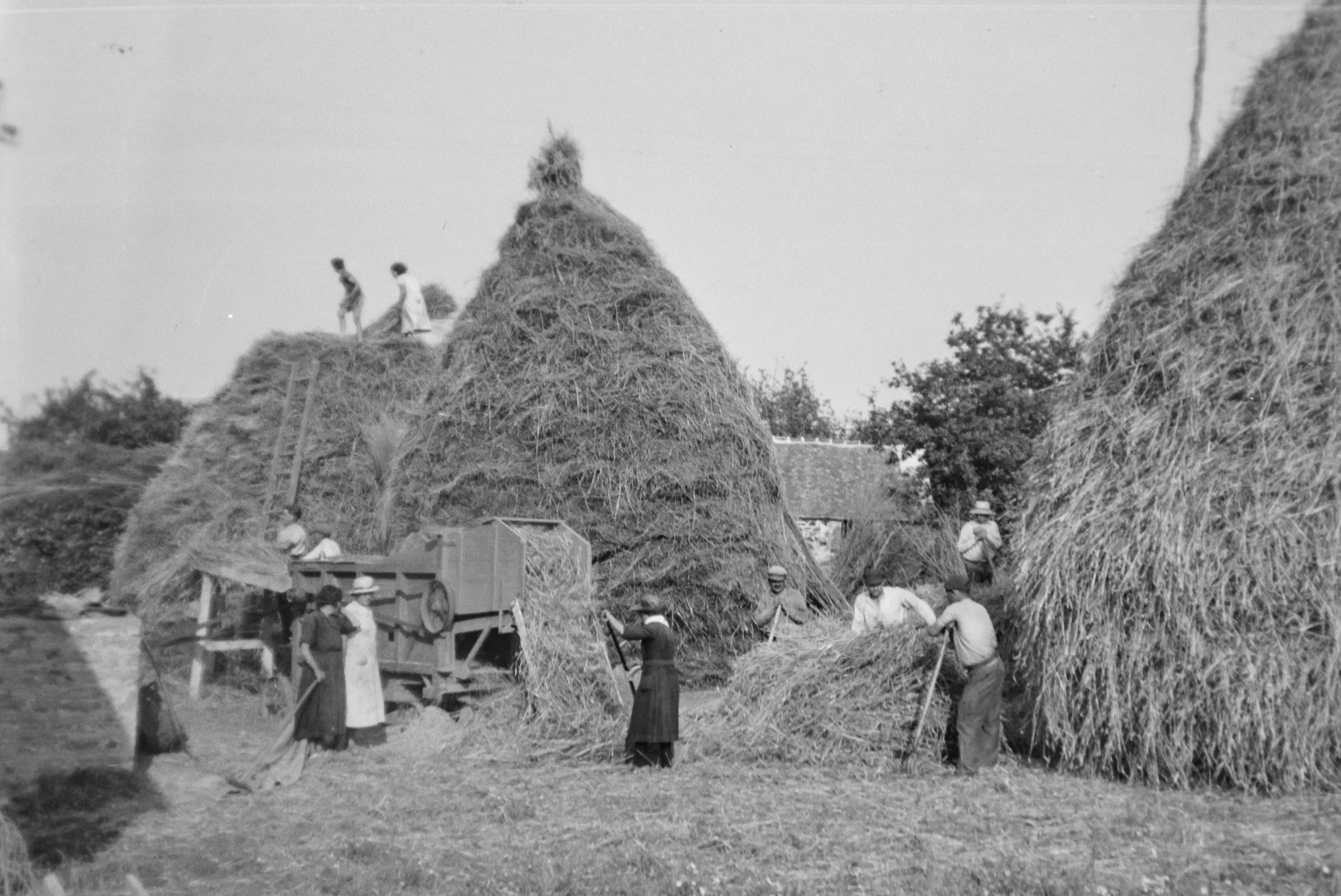
Like Hall’s ancestors, I also come from a long line of hard workers. My ancestral proclivity for hard work comes to me directly from my paternal grandparents. My great-grandparents were Volga Germans, born in Kautz, Russia, and eventually emigrated to Germany. My grandparents, also born in Russia, resisted Russification within their agrarian community. Idealizing work helped them maintain their ethnic and cultural identity. Arbeit macht das Leben süss. School was optional, work was not. By the time my grandparents immigrated to Laurel, Montana in 1951, they had spent their entire childhoods working. Work was a essential part of their immigrant lives.
Donald Hall’s great-grandfather, Benjamin Keneston, bought Eagle Pond Farm in 1865, and as Hall details in Life Work, his family continued to work the land for generations. In String Too Short to Be Saved, Hall remembers working alongside his grandparents gathering eggs, milking cows, and haying fields. These chores gave him a sense of usefulness, skill, accomplishment, and most importantly, belonging. Hall felt a deep connection to his maternal grandparents, their land, and the work.
“On the farm I felt myself protected by the old in a gallery of the dead. They sang that I was their own.”
Hall’s family grew to be self-sufficient New England farmers, successful members of New England’s upper class society. My family became another unrealized American Dream, forever working for comfortability, always just out of reach. Work that is unrelenting and unsatisfied, Hall describes as “hymns of dirt-work” whose “chorus [is] below the level of our consciousness.” These ancient hymns shape who we are.
Hall says that “although their work was endless, I never heard my grandparents complain about it or whine. Work was there like Mt. Everest.” I can say the same about my own grandparents. Though the work never ceased, my grandparents (like Hall’s) seemed to enjoy their work. They took pride in working hard and working well. It also gave them a strong sense of usefulness, skill, accomplishment, and belonging.
Our ancestors’ similar conviction of and devotion to work is what drives and defines us. Donald Hall was an American poet, writer, editor, and literary critic. In his 70-year career, he wrote over fifty books across multiple genres, including poetry, memoirs, children’s books, and essays. Adrian Neibauer is a teacher. In his 25-year career, he has taught over 800 students across multiple school buildings. While I am not setting my work next to that of the 14th Poet Laureate and National Medal of Arts winner (among many others), I am doing so only to observe that both of us work-work-work.
I’ve never worked a day in my life.
Donald Hall, Life Work
Teaching did not always feel like work. In my first decade in the classroom, teaching engrossed me. My students’ energy, challenges, needs, excitement, it all absorbed me in the task of educating them. I was working hard, but it never felt like work because, as Hall believes, I was content. “Contentment is work so engrossing that you do not know that you are working; contentment [is] absorbedness.” Hungarian psychologist, Mihaly Csikszentmihalyi, would call this “a state of flow — a state of concentration or complete absorption with the activity at hand and the situation.” When you enter a flow state, you are so absorbed that nothing else matters. The challenge of what you are trying to learn/do is the same as your skill/current understanding. You are not bored or disinterested. You are in a state of heightened consciousness. When Hall was writing at his desk, he described himself as “utterly happy, utterly unself-conscious.”
Teaching became work when worry and dread replaced passion and challenge. Staff meetings and standardized lesson planning became banal checklists with endless desultory tasks. There was less work-excitement and more chore procrastination. Unlike my (and Hall’s) grandparents, I did complain. I tried my best to adapt to the changing landscape of public education. 15-Day Challenges replaced novel studies and I worked to find glimmers in absurdities. I remained devoted to my students, but passively resisted as much as I could, retaining as much of my humanity as possible.
In 1929, my paternal great-grandfather, George Schreiner, was forced out of his home (along with five other families) and transported to Siberia. He was not a rich farmer, but whatever land and livestock he owned was forfeited, as part of Stalin’s forced collectivization. Men were separated from women. He spent eight months in prison, and then upon release, was unemployed; forced to beg for bread. He spent the next twenty years intermittently traveling around Russia, looking for farm work, before finally settling in the town of Eislingen, Germany in 1952 as a displaced refugee.
Following the Nazi invasion of the Soviet Union in 1941, in Stalin’s paranoia, he abolished the Volga German Republic, viewing all ethnic Germans as potential Nazi collaborators. The Soviet government forcibly deported roughly 500,000 ethnic Germans from the Volga region to the hinterlands of Siberia and Kazakhstan. Working-age adults were put into the Trudarmii (Labor Army), essentially functioning as slave labor in concentration and labor camps. In 1943, my paternal grandfather, Alex, was forced to work in the Trudarmii in a labor camp. I cannot fathom this work.
Neither can Donald Hall fully understand his maternal grandfather, Wesley Wells, working alone for decades chopping cordwood on the Ragged Mountain.1
Cutting wood in January was the hardest chore of the year. He milked early, ate breakfast, and climbed Ragged with an axe and a lunchpail. All day his axe wedged chunks of hardwood onto snow — ash and maple, oak and elm — the shock and shudder of steel blows aching along his forearms into his shoulders. Because this work was routine, it was endurable through strenuous; keeping steady pace, he worked past soreness. Sweat froze on his forehead when he stopped to catch his breath. When he chopped down a tree he cut off the branches and cut the burnable trunk and the greater branches into four-foot lengths for transport. He took one break, to eat his lunch, and finished as the afternoon finished. Then he walked down Ragged’s icy hill to the relative warmth of milking wedged between Holstein bodies.
I cannot imagine how this type of work could ever become routine. And aside from only getting one break for lunch, my teacher work (just has Hall’s writing work) pales in comparison. Just as I fear placing fifth-grade teacher next to Poet Laureate will elicit ridiculous comparisons, I worry that I have no business complaining about following a standardized curriculum guide when my ancestors literally worked to survive. Wrangling thirty recalcitrant kids seems like first-world problems in comparison. For most people, work is a necessary part of life. Both my ancestors and Hall’s understood that “work is what we do to feed ourselves and keep ourselves warm.” Not everyone is lucky enough to have a job that one loves so much that they love going to work.
And yet, teaching (like writing) is work. There are days when teaching does not feel like work; lessons go as planned, students are engaged and make connections, excitement is high, stress is low, learning happens. Then there are many days when teaching feels like a Sisyphean labor. As a fellow writer, I know what it feels like when the words do not come. When making sentences is hard work. After twenty-five years as a classroom teacher, I have had many days when teaching was hard work. When my students would not listen and the arbitrary tightening of mandates left me weary. Writing is the work Hall wanted to do with his life; his life work. Teaching is mine.
By the end of Life Work, Donald Hall asserts, “I would not let it happen to me; I would do what I wanted to do; I would work at the work I wanted to work at.” Cancer has a knack for clarifying, putting one’s choices into perspective. When Hall was diagnosed with liver cancer, he resolved to continue working. “If work is no antidote to death, nor a denial of it, death is a powerful stimulus to work. Get done what you can.”
The secret of life is to have a task, something you devote your entire life to, something you bring everything to, every minute of the day for your whole life. And the most important thing is — it must be something you cannot possibly do!
When working with Memento mori in the front of one’s mind, it can help transform mundane chores into meaningful jobs. Likewise, the pandemic helped me reshift my teaching job from one of painful obligation to that of a diligent duty that is rooted in my values as a human being. In June of 2022, I wrote the following.
Teaching is my purpose in life. It’s my calling. It’s what wakes me up in the morning excited. It’s what keeps me energized at 2 PM after a challenging day. Teaching is what keeps me going when I am overwhelmed with stress.
The pandemic changed everything. The last two years have been the most challenging, frustrating, scary, life-threatening school years in my 20+ year career in public education. I have never put more of myself into my students. I have never been this vulnerable. I have lost count the number of times I felt scared, helpless, defeated and exhausted. I continue to do the best I can under impossible circumstances. I know that I’m a good teacher, but I know I was not the best teacher during pandemic.
Now is the time for a wakeup call. It is time to answer the call, hold myself accountable, and take action.
I do not know if Donald Hall ever felt that writing was his calling. I do know that he loved writing, perhaps as much as I love teaching. Hall insisted that it is “because I loved my work it was as if I did not work at all.” That is how I felt about teaching in my first decade in the classroom. I would wake up, eat breakfast, pack my lunch (always PB&J, chips, and an apple) and go to school. I loved school! I loved seeing my students and being a teacher in every possible way. I loved doing all of the teacher things: arranging desks, explaining concepts, writing on the board. I never minded the more insipid tasks like grading papers, attending staff meetings, or cleaning up the classroom at the end of the day. It was all in service to being a teacher. But as Hall believed that there is “no reason to spend your life writing poems unless your goal is to write great poems”, I began to lose my teacher-work-excitement because I was not being a great teacher through and after the pandemic. The “joy-pressure” Hall describes as building before he would sit at his desk, “open the folder that holds the day’s beginning, its desire and its hope” just felt to me like pressure. As the minutes ticked toward the morning bell, the pressure would build, and continue building throughout the day. Micro-misbehaviors accumulated; systemic nonsense continually collected at my feet until I began to feel suffocated. Academic traumas were littered throughout the school system. Teaching became avoiding landmines rather than embracing the beautiful uncertainty of the classroom. I could not spend the rest of my teaching career working this way. I would not. My goal has always been to be a better teacher with each passing day, so I made a change to improve my teacher-life work.
Luckily, I do not have a terminal illness acting as my wakeup call. The pandemic years are over. I am now excited to return to the work of teaching instead of the teaching job. I enjoy teaching students too much to call it a job. My classroom will always be a place where I can be my most human self, help my students be their most human selves, and teach. Like Hall, I can read poems aloud to my students and praise authors and books that I love. I can get students excited about learning. Of course, many of the same frustrations will continue to be a part of every batch of new students. There will always be those that struggle with learning, those that even hate to read or write. But this time, I am leaning into my values and passions. The standardization of public education is still very much a daily part of quotidian schooling. This time, I am giving myself permission to get excited again about the things that matter (students, content, and craft), and ignore the stuff that is unimportant (pacing guides, initiatives, edtech).
Hall believed that it is a great privilege to enjoy one’s work. He felt that his writing career was a lifelong devotion, viewing his daily discipline of writing as “heaven.” He wanted to “to make words that live forever.” I believe that it is my great privilege to be a public school teacher. I am devoted to the craft of teaching, and will always work to humanize my classroom for my students. There will be days when teaching will feel more like a chore or a job, but the work of teaching is one of my greatest joys: life work.
Perhaps that now I am fully into middle age, I can reflect on my past years, and still have time to make actionable changes. In Henry James’ The Middle Years, the novelist, Dencombe, is dying. In one scene, he is resting at a spa and beginning to read a novel when he suddenly breaks down weeping: “he felt not so much that his last chance was going as that it was gone indeed. He had done all that he should ever do, and yet he had not done what he wanted.” I will not enter the last decade of my teacher life holding onto to the frustrations and regrets from these last six years. I am not looking at next year as a second chance, but a fresh start to be myself again. For as Dencome’s admirer says, “A second chance — that’s the delusion. There never was to be but one. We work in the dark — we do what we can — we give what we have. Our doubt is our passion and our passion is our task. The rest is the madness of art.” Teaching is my passion and art, and I will have many “best days” ahead of me. Teaching has always been a loving sanctuary for me, much as writing was for Donald Hall. I plan to spend the rest of my teaching years disciplined, engrossed, and rooting myself in the humanity of teaching and learning. After all, I have a lot of great work to do.
Have a great week!
— Adrian
Resources
This clip is part of a larger interview with Donald Hall. In this clip, Hall discusses his working habits and how he feels about writing as a job. I take a lot of lessons from Hall and apply it to my relationship to teaching as a career.
Before Donald Hall died, he let a filmmaker into his home at Eagle Pond Farm. The result is this incredible 15-minute documentary.
Growing up with my immigrant grandparents, I came to appreciate the beauty of intergenerational relationships. I have learned so much from my ancestors. Now, I realize that being 45 years old is not really old, but this documentary is wonderful! The residents of the Hebrew Home at Riverdale discuss how their lives have improved in their twilight years.
In this video Ryan Holiday explains the Stoic concept of memento mori. If you are Stoic-curious, I recommend reading The Daily Stoic. Here is Holiday discussing stoicism.
Once again, John Spencer offers a clear explanation of an important concept in education. Flow theory began in the 70’s and 80’s when Csikszentmihalyi became fascinated by artists who were so lost in their creative work that they would lose track of time and ignoring food, water, and sleep. Through his research, he noticed a similar experience with scientists, athletes, and authors. It was a state of hyper-focus and complete engagement that he described as “optimal experience.”
This summer, take time to watch this 90-minute interview with Rick Rubin. He describes himself as a lazy workaholic. At times, his Zen exterior makes it difficult to fully understand what he is saying, but in this interview, Rubin does an excellent job distilling down the key components of finding your life’s work.
Summer Success Series Pt. 8: Work versus Chores | Robyn Jackson
When Robyn Jackson’s book, Never Work Harder Than Your Students came out, I was lucky enough to listen to her speak. In this podcast episode, Jackson discusses the duties administrators do and how to realign that with meaningful work. She distinguishes it as spending time doing the chores of administration like a leader or doing the work of administration. This is a great summer listen!
Affirmation by Donald Hall | Academy of American Poets
This is one of my favorite poems by Donald Hall. I appreciate it more as I age.
Humans: a podcast about humans
There are so many podcasts! However, if you are looking for something excellent to listen to, I highly recommend Hank Green’s newest podcast: Humans. Here he is discussing the importance of remaining human while being on the internet.
Elegized beautifully in “An Elegy for Wesley Wells,” in Exiles and Marriages.
More elegant, beautiful reflections. I love reading your words.
I also wonder what’s in store next year! (I might have missed it, so no need to respond as I will catch up at some point.)
In my best moments, I have had the exact same feelings about teaching (and leading), right down to packing my PB&J in my early years teaching.
The one thing I would add, which I still feel with profound amazement, is the gratitude and honor I have felt for parents and guardians trusting me with their children every day. It’s an astounding situation that really has no parallel elsewhere in life.
This essay has really sparked my thinking, helped me reflect on the jobs in schools that felt like they filled my soul vs. the ones that I had to slog through.
I'm not sure I agree with you that your job is easier than manual labor of chopping wood all day. Honestly, the emotional and cognitive labor that teaching requires is HARD... I wonder if you had given the wood chopper the choice to do what he's doing or what you're doing, which he would pick. :)