
This is Air
Understanding and Changing the Way Teachers and Students See School

When I returned to the classroom in August 2020, six months after a global pandemic shut down schools and halted day in day out reality, I was arrogant in my abilities. I had been a classroom teacher for thirteen years and an instructional coach for five. I had led numerous professional development trainings for teachers, principals, and administrators. I had presented at conferences. I knew how students learn best and I knew how to teach. My job was to help teachers improve by inspiring them to teach in creative and innovative ways. I employed a variety of geekspeak, suggesting teachers create learning ecosystems and idea incubators in their classrooms. I spoke audiciously about think tanks, exponential growth, and second-grade entrepreneurs. My progressive rhetoric was filled with destructive, Silicon valley jargon: Move Fast and Break Things; Fail Fast, Learn Faster; Disrupt the Status Quo. I was convinced that public schools needed a full overhaul via STEM. I wanted students holding iPads and wearing Augmented Reality (AR) glasses, simultaneously learning while engineering the future. I fully endorsed Microsoft’s vision of the classroom of the future.
During my time as an instructional coach, I viewed public education as an outdated system in dire need of dismantling and transformation. Exponential technologies were going to save schools from going extinct, innovative teachers leading the way.
The 2020-2021 school year was a gut-punch to my hyper-idealized, technology-infused, makerspace vision of the future. Despite all of the creativity and hard work teachers put into teaching lessons online, remote learning was a disaster. Teachers spoke to an array of black squares while students pretended to listen while playing video games. There were no grades or accountability, and students lost more than academic learning: social-emotional development, peer bonding, the ability to resolve conflicts, and regulate their emotions. When everyone arrived for in-school learning, wearing masks and terrified of contracting COVID-19, my visions of the future of education quickly vanished. My day in day out duties entailed incessant reminders for hand washing, wearing masks above the nose, and keeping students six-feet apart. Students seemed to forget how to operate in a public school classroom. It was a mess.
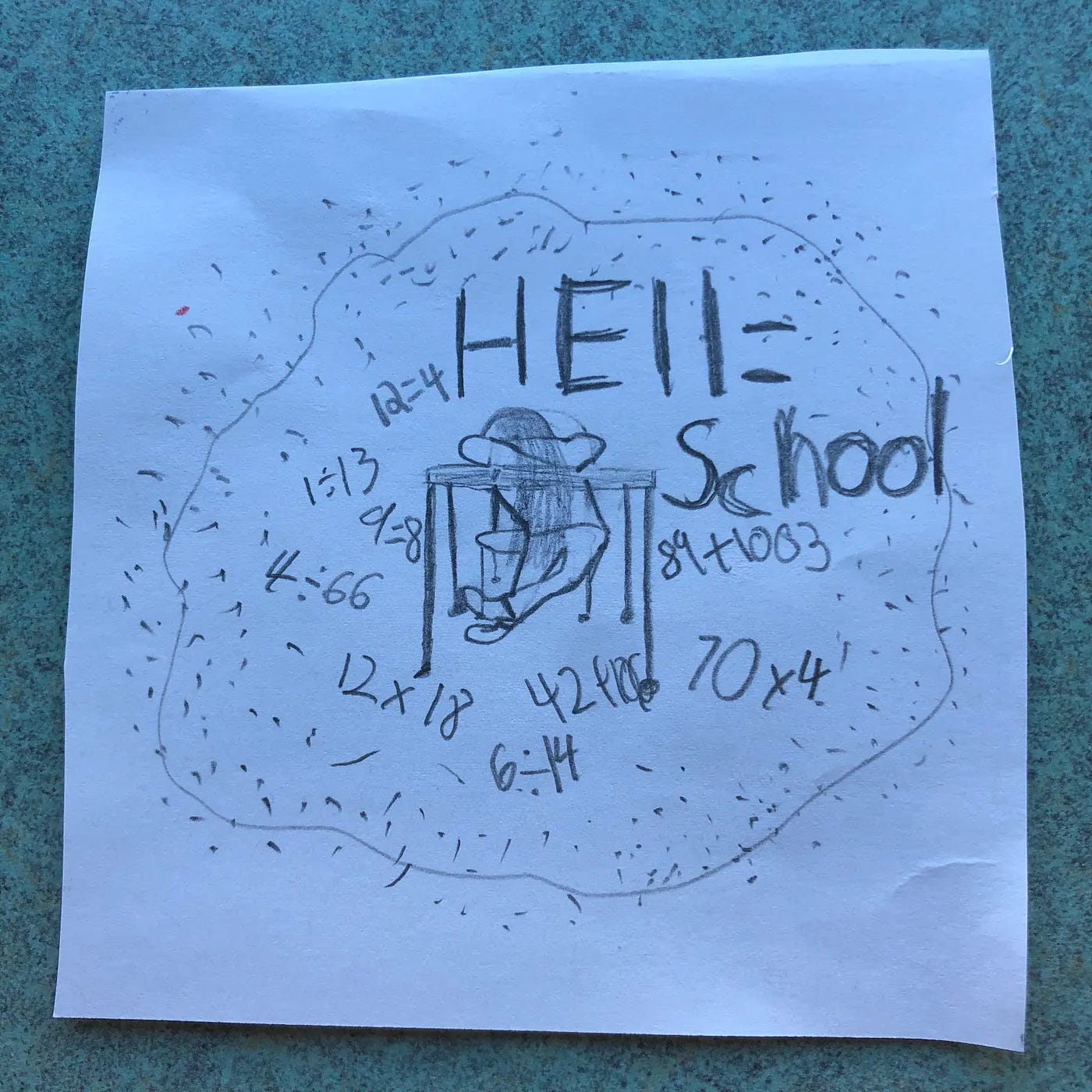
One afternoon, after an especially difficult day, I found a student doodle on the floor.
Hell = School
Learning how to think really means learning how to exercise some control over how and what you think. It means being conscious and aware enough to choose what you pay attention to and to choose how you construct meaning from experience.
David Foster Wallace, This is Water
In 2005, David Foster Wallace, in speaking to Kenyon College graduates, takes the most “pervasive cliché in the commencement speech genre, which is that a liberal arts education is not so much about filling you up with knowledge as it is about teaching you how to think” and expounds (as only DFW can) about what this means in the day in day out of the real world. Through a fish parable, a didactic story about two guys in a bar discussing the existence of God, and his brilliant description of the banality of grocery shopping as an adult, Wallace counsels graduates to consciously choose to think differently, not to go through life on autopilot, simply because it is one’s default setting. Learning how to think is “consciously decid[ing] what has meaning and what doesn’t” and this requires “exercis[ing] some control over how and what you think.”
The two men in the bar view the experience of almost dying in an Alaskan blizzard differently because they have “two different belief templates and two different ways of constructing meaning from [that] experience.” I spent my five years as an instructional coach looking at public education differently than the teachers in the classroom. My ability to come in and out of team planning meetings or lessons meant that I missed seeing the slow dehumanization of teaching and learning happening day in day out. While I was going to innovative conferences, focusing on infusing every classroom with creativity and technology, teachers were battling an unraveling of public schools. In the years leading up to the COVID-19 pandemic, schools saw decreases in student enrollment, classroom funding, access to creative arts programs, and recess. As school accountability tightened, so too, did standardized testing, leading to mass purchasing and implementation of mandated boxed curricular programs that promised higher test scores. The cracks were always there, but I could not see them from my vantage.
The pandemic did not make students and teachers hate school. Closing schools and forcing everyone online only magnified a growing disillusionment. Schools were no longer seen as safe places for students to laugh and learn and experiment and grow. Schools were now filled with scary directives, forced separation, and mandated seat time in order to somehow recover from the now unavoidable massive academic gaps. If you were a classroom teacher in the years prior to the pandemic, you probably heard the bus metaphor: school/learning is a bus and teachers are the drivers of the bus or the breadcrumbs metaphor: teachers guiding students’ learning by leaving breadcrumbs. In fact, before the pandemic, many saw schools as a mysterious black box, the daily operations of classrooms unseen to those outside of public education. As everyone emerged from quarantines and reentered school buildings, a veil had been lifted. Teachers were struggling to teach; students were struggling to learn. The pandemic did not create learning loss. It exacerbated an already present problem: students did not see schools as places for curiosity and deep learning. School = Hell.
Conceptual Metaphors
The greatest thing by far is to have a command of metaphor. This alone cannot be imparted by another; it is the mark of genius, for to make good metaphors implies an eye for resemblance.
Aristotle, Poetics
Metaphors are an integral part of being human. They exist at the earliest signs of language because they shape our conceptual human understanding of the world. Metaphors are fundamental to how we share and conceive of human experiences. In Conceptual Metaphor in Everyday Language, linguist George Lakoff and philosopher Mark Johnson explain that metaphors “govern our everyday functioning, down to the most mundane details. Our concepts structure what we perceive, how we get around in the world, and how we relate to other people. Our conceptual system thus plays a central role in defining our everyday realities.” This is how David Foster Wallace is able to relay the story of two different men interpreting the same event differently.
As a teacher, I have heard so many metaphors about teachers, school, teaching and learning, and public education, that many of them have become painfully trite.
Teaching is a marathon, not a sprint.
Education is a ticket to prosperity.
Education is a ship and teachers are steering the ship.
Teachers are beacons of light.
Teachers fill students minds.
Teachers mold young minds.
Knowledge is transmitted to students.
Teachers are superheroes.
Some of these metaphors place teachers in active roles as gatekeepers of knowledge, and relegate students to passive positions. Some acknowledge the difficulty of teaching (change in public education is slowly turning a ship), while others create the toxic persona of teachers as valiant knights saving students through heroic methods. Metaphors for schools are even more prevalent and can be just as problematic.
School as a Garden
The most common metaphor for teaching is gardening. The 17th century philosopher and pedagogue, John Amos Comenius, believed that schools should be attached to gardens so “children can have the opportunity for leisurely gazing upon trees, flowers and herbs, and are taught to appreciate them.” Friedrich Froebel, a 19th century German educator who is credited for creating Kindergarten, based his approach to teaching children on play and activity. Kindergarten, literally translates to children’s garden representing a garden of children where they are nurtured by loving teachers. The school as a garden metaphor suggests that the growth potential of each student is analogous to a seed; teachers just need to provide the proper nutrients for growth. While a lovely image, this metaphor does not take into consideration the reality many students face in 2026. If plant seeds had access to social media and video games, I doubt it would venture out of its seed coat. Students may have an innate desire to learn and grow, but that natural inclination is stymied by addictive technology.
School as a Factory
Public education was designed to separate children into groups of obedient, compliant, workforce-ready cogs. Instead of educating children with unique intersections of race, gender, identity, strengths, and weaknesses, we dispense and grade standardized lessons. In this sense, public education has been a very successful system; unchanged for years. Many historians have shown how public school classrooms are modeled after factories with the machine-like productivity of assembly lines. Students are separated into grades, the school day is broken into periods, transition bells mark the hours, and drill is the sole method for productive learning. The only way to fix public education is to dismantle the factory or break the machine. This metaphor takes all agency away from teachers and students. Cogs do not think for themselves, and so what is the motivation for teaching students to think critically?
School as a Prison
Related to the school as a factory metaphor, seeing school as a prison is disheartening: students face a mandated sentence of thirteen years (K-12), forced to spend their days with adults who dictate their every movements. When you include the increase of zero-tolerance policies for disciplining students of color, more security involvement in school discipline, metal detectors funneling students into the building, and disproportionate suspension and expulsion rates for students of color, this metaphor extends to a more terrifying image: a school-to-prison pipeline. When school is viewed this way, the students most at-risk are pushed out of the classroom and into the juvenile and criminal justice systems, prioritizing incarceration over education. Teaching during the early months of the pandemic, I saw a rise in zero-tolerance discipline for not complying with the health requirements for face-to-face learning.
School as a Business
In this metaphor, students are the products, teachers are the workers, and parents are the customers, often dissatisfied with the quality of education their students are receiving. This metaphor has made public education an easy target for injections of “silver bullet” fixes (another metaphor!) and educational technology. All schools need to do is adopt a standardized curriculum, plug students into expensive devices, and monitor. Charter schools, publicly funded tuition-free schools of choice that have greater autonomy than traditional public schools, have benefited from this metaphor. If one school is not “operating” to one’s specifications, you can either choose another school or create a school of your own. The first charter school was established in Minnesota in 1992. Since then, the charter school movement has experienced tremendous growth. From the 2003–04 to the 2013–14 school year, the number of charter schools in the United States has doubled, growing from 3,000 to 6,000, with the proportion of students enrolled in these schools increasing from 1.6 to 5.1 percent. When schools are run as businesses, poor performance or toxic culture is often addressed with quick changes to the building’s administration or school’s staff.
David Foster Wallace ends his commencement speech, This is Water, urging students to “stay conscious and alive in the adult world day in and day out” because one’s awareness is the “real value of a real education.” Because metaphors are everywhere in our language and lives, they remain central to one’s perceived experiences. Andrew Ortony, scholar and author of Metaphor and Thought, explains that metaphors are “closer to emotional reality.” Metaphors can give insight into one’s interpretation of an experience, even if it is shared with others, because they are, as Ortony says, the “essential ingredient of communication.” Even as we experience the world differently, metaphors help us understand our world and share it with others. Collective humanity.
DFW reminds graduates that to stay alive in the adult world is an arduous task. Going to school day in day out, it is easy to lapse into autopilot and fail to see the metaphors used to describe teaching and learning in a public school system. Students, on the other hand, are often more aware of the hidden curriculum that surrounds their day in day out schooling experience. These unwritten rules, unspoken expectations, and unofficial norms, behaviors and values are steeped in metaphors, directly related to how students see school, teaching, their learning, growth, and failure.
How Students See School
How do students see school? How do they see their teachers? How do students view their learning? What do students think of as getting an education? I have been wrestling with these questions since returning to the classroom in 2020. The etymology of the word education, comes from the Latin root, educatio, meaning to “bring up or nourish”, while educere means to “draw out.” Christopher Perrin, classical educator, explores this on his podcast, The Christopher Perrin Show.
If there’s a metaphor in the word educatio, it’s to lead out or to unfold; it’s not marshall training. It’s nurturing. It’s raising a child.
I worry that since 2020, students see school as forced training for work they do not even want to do when they are older. I have had more than my share of challenging students who view me as a faux-authority figure with no actual authority. I have had students refuse so many things that make up the overall school experience, I wonder if what they are really communicating to me is that they refuse school as an institution. Why listen to Mr. Neibauer when he makes me do things I don’t want to do? I don’t have to do that! I wonder what my students think of being in school. I am curious to know what their beliefs are around the idea of getting an education. Has this changed in the last decade? 35 years ago, when I was a fifth-grader, abject refusal in school was not a concept I knew. Sure, I remember resisting making my bed or cleaning my room, but in the end, I did what I was told because saying no was not an option. Especially in school, I would never even consider yelling at a teacher, refusing to sit down or do my class work, or intentionally be disruptive and disrespectful to my classmates. In the 90s, my metaphor for school was as a necessary pathway to future success. Today, I do not think my Generation Alpha students see school as needed. They have grown up with pervasive technology at their fingertips since they were toddlers. They get bored easily and struggle with independent accountability. Many of my students lack boundaries, have poor behavioral regulation, and struggle with any authority, including their parents. Whether this a parenting problem or a metaphor problem, I believe the solution lies in changing the way students see school. I am not competing with TikTok for their attention, and I refuse to pander to their demands. But what I can do is to help change the metaphor around what is school and what is it for.
A New Metaphor
“Think about it”, David Foster Wallace says:
There is no experience you have had that you are not the absolute centre of. The world as you experience it is there in front of YOU or behind YOU, to the left or right of YOU, on YOUR TV or YOUR monitor. And so on. Other people’s thoughts and feelings have to be communicated to you somehow, but your own are so immediate, urgent, real.
If this was the default setting of those graduating seniors in 2005, this is certainly my current students’ default setting. Very few people have pushed them to think outside of themselves. In fact, during their formative years before the pandemic, the world was pushing them to think only of themselves. And now, at the ages of 10-11, their Elder Millennial teacher is frustrated that they are self-centered and unapologetically disengaged. They struggle with controlling their impulses, so of course they struggle to exercise control over how and what they think. Many students view school as a waste of time because time for them is measured in 2:30 TikToks and skin care trends. I have had many students over the last five years not come to school because they “don’t feel like it.” Meaning has been reduced to memes, while abstract concepts like education or learning seem so uselessly abstruse, they are unnecessarily esoteric.
Instead of trying to force students in 2026 to reconcile their schooling experiences to metaphors that are meaningless to them, perhaps we should create a new mental model for students. My impulse is to return to the Silicon Valley slang I was immersed in as an instructional coach. What if school is an innovative research lab or Skunk Works? My students know nothing of Google X or Design Labs. Unfortunately, they are egocentric consumers of technology, not altruistic agents of change. They are downloading apps, not designing them. As DFW envisaged two decades ago, my fifth-grade students are lost in infinity loops of themselves, reflected endlessly through their social media and video games. They have become dopamine tyrants.
Students have no idea what life beyond traditional public schooling looks like. The truth is, no one does. Since the beginning of the 21st century, we have been trying to predict what life post-school looks like in a techno-futuristic society, and preparing students for future jobs that do not exist. We keep failing because public education has been focusing on (or worshipping, as DFW says) the wrong things. When schools focus solely on raising standardized test scores, then the default setting becomes a rat race, by any means necessary: basal textbooks, lowered curricular standards, ChatGPT, gamified learning apps, HQIM that are anything but high quality.
Students see it all. We have trained them to focus on apps instead of books. We misled them into believing that reading was scanning and skimming text to look for answers to multiple choice questions and writing was engaging with LLMs. And so is it any wonder that many students have lost sight of what is the value of education? Can we be surprised that students do not use powerful metaphors to make sense of school?
The capital-T Truth is students need to understand that learning is the air we breathe. Learning to read, write, think, communicate, appreciate, disagree, and exist in a common, safe space with other people who have different experiences from your own, all of it we call school is “what is so real and essential, so hidden in plain sight all around us, all the time.” Learning is not optional; you cannot opt out of breathing. You can either do it automatically, or with simple awareness, as DFW urges us to do. Sometimes breathing will be labored. At times, your heart rate will elevate, and you will struggle to catch your breath as you climb a steep hill or exercise your body. When your sides ache and your legs cramp, you will want to stop; you may even pause to rest your muscles and catch your breath. But your lungs never stop working. You continue breathing because to learn is to be human and fully alive. The more you workout, the better shape you will be in for the next challenge. The more you learn, the better human you will be when faced with uncertainty, doubt, and difficult choices.
I love how Ethan Hawke explains why we need art and creativity in life.
Most people don’t spend a lot of time thinking about poetry. They have a life to live and they aren’t really that concerned with Allen Ginsberg’s poems, or anybody’s poems. Until their father dies. They go to a funeral. You lose a child. Somebody breaks your heart. They don’t love you anymore. And all of a sudden, you are desperate for making sense out of this life, and has anybody ever felt this bad before. How did they come out of this cloud? Or the inverse. Something great. You meet somebody and your heart explodes, you love them so much, you can’t even see straight. You’re dizzy. Did anybody feel like this before. What is happening to me? And that’s when art is not a luxury; it’s actually sustenance. We need it.
Learning is like that. We need it to survive. We need to read whole novels, listen to entire albums, read poetry, see live performances, sing, dance, debate in classrooms, challenge textbooks, and think critically about concepts. We need to write with pencils and paper and scribble marginalia over real literature. We need these experiences. The answer to When will I ever use this in life? is not some specified future point. It is life. Learning is the air we breathe and to stop learning is to die. To succumb to students’ base dopamine wants is to exile them to an empty life. School is not required because it is in preparation for future employment, income, or happiness. Going to school teaches students how to “stay conscious and alive in the adult world day in and day out.” And so we keep reminding ourselves over and over.
Learning is air.
This is air.
Have a great week!
— Adrian
Resources

I will always suggest you read anything written by Ted Gioia. This piece about David Foster Wallace is so good, and ends with Wallace’s (and Gioia’s) plea for more kindness and compassion.
Róbert Bohát argues that learning metaphors have a significant impact on student motivation, engagement and success in school. The power of metaphors can be shown in other fields besides public education. My favorite section of this TEDx Talk is about metaphors in the medical treatment of disease.
I cannot believe that this TED talk is almost 15 years old! Tim Magner suggests that we change the way we look at schools and develop a new operational metaphors. His suggestions, especially considering the age of this video, make me think about how I want my students to see their public school building.
Fred Bahnson, director of the Food, Faith, and Religious Leadership Initiative at Wake Forest University School of Divinity, speaks beautifully about the garden metaphor. Listening to its biblical origins has me rethinking how I may use it when describing school.

I always enjoy listening to Christopher Perrin discuss classical education. Although I work in public schools, I find Perrin’s exploration of etymology helpful in creating a better metaphor for teaching and learning.
Why Metaphors Are Necessary and Not Just Nice | Andrew Ortony
This paper by Professor Emeritus, Andrew Ortony, is over 50 years old. Still, his discussion of the important pedagogical value of metaphors is so insightful. I particularly appreciate his vividness thesis, explaining that metaphors are much closer to one’s perceived experience than non-metaphorical equivalents.
How Metaphors Shape Our Ideas About Education | Forbes
This is an discussion between Julia Turchaninova, former senior teacher from the Houston Independent School District, and Julia Brodsky, Forbes Education contributor. Turchaninova knows what she is talking about and I felt affirmed in much of my teaching experiences post pandemic. She ends saying, It would be great for us as a society to come up with a new set of metaphors that help us express the essence of the kind of education we want for our children in the upcoming century. YES!!
This metaphor blew my mind! What if we saw learning as a rhizome? Experience Anatomist, Christopher Roosen explains, “With a rhizome, learning is a networked and bi-directional system. The learner extends and enriches their knowledge and skills. Rhizomic learning means that learning provides a power source for growth.” This is a fascinating read!
Great post! I read and chuckle: For a month I've been sitting on a post called "50 Metaphorical Prompts About High School." I'm still going to post it soon, but you gave me pause.
Also, Metaphors to Live By is such a fantastic book!
Your breakdown of these metaphors really highlights how the language we use unconsciously shapes policy decisions. The school-as-business metaphor you mentioned has been particularly damaging because it's led to treating education like any other market commodity that can be optimized through competition. What's missing from most of these metaphors is any sense of school as a community space where relationships and belonging matter as much as academic outcomes.