
Literary 3x3s
Motivating My Students to Read By Any Means Necessary


When my children were babies they were very picky eaters. Whenever we introduced them to a new food, we would “hide” it on the spoon, sneakily placing it behind a food we knew they liked. I would scoop a small amount of puréed spinach and then dip the front of the spoon in some mashed bananas. More often than not, my children would eagerly take the bite of banana, even if there was a bitter aftertaste of broccoli. It didn’t always work. Once my middle son caught on, we had to increase the amount of banana in each bite trying to get them to eat their vegetables. As a new parent, I often fretted when my son refused to eat. Every time he spit out some bitter puréed vegetable, I quickly scooped it from his chin and tried to get him to swallow it.
We read all of the baby books. Each one encouraged us to stay patient and keep trying different foods because babies often need to try a new food at least 15-20 times before accepting it. So, whether it was mashed avocado, asparagus, or peas, we kept at it. When hiding the vegetables in bananas no longer worked, we tried yogurt. When that stopped working, we tried sweet potatoes. The goal was always for them to eat well.
35 years ago, schools encouraged students to read by hosting Scholastic Book Fairs, holding reading competitions between classes, and celebrating the nationwide Read Across America. Teachers assigned book reports to be presented on trifold cardboard displays, and before summer break, teachers promoted summer reading programs. There were so many incentives offered: bookmarks and award certificates; sparkly pencils and fun pencil toppers; stickers and stamps; buttons and coupons. And if the entire class met a reading goal, teachers celebrated with a class party and extra recess.
Even though I was not much of a reader in middle and high school, books and reading were everywhere. The school library’s walls were plastered with famous athletes, musicians, and celebrities all holding books encouraging students to read. Every time the Scholastic Book Fair came to the school, many students eagerly awaited the newest book in the Choose Your Own Adventure, Goosebumps, or Babysitters’ Club series.


When I got home from school and turned on the television, I watched shows like Reading Rainbow and CBS Storybreak. I may have avoided reading, but I could not escape the ubiquitous culture of reading in the 1980s and 1990s.
Today, getting upper elementary and middle-grade students to read feels like trying to feed a picky eater. No matter what book I suggest, they spit it back out. A couple of years ago, when chatting with a student and trying to suggest a novel, they looked at me in earnest and said, I don’t do reading. I can relate to struggling readers, but this comment shocked me. How could one simply not do reading? Growing up, reading was like breathing: even if I did not read for pleasure, everyone else always seemed to be reading, even Yoda and Big Bird. Now, the reverse seems to be true: no one is reading.
Novels are disappearing from classroom bookshelves and libraries. I have walked into classrooms with no classroom libraries and no books for students to check out and read. Before the pandemic, our school district embarked on massive school library renovations, redesigning spaces to “create open and innovative environment[s] beyond the traditional classroom.” This meant drastically reducing physical book collections and emphasizing technology infrastructure and flexible, collaborative learning spaces. As a result, most elementary school libraries have a limited selection of physical books. Instead of comfortable reading nooks, students are encouraged to read ebooks on their laptops using apps like Sora and Epic. If classroom teachers schedule time to visit the library, they are responsible for checking in and out books. Most school librarian positions have been cut, replaced with part-time staff to shelve what few books remain. The Scholastic Book Fair still visits schools a couple of times each year, however, the book selection is meager. Instead of browsing shelves of Newbery Award winning novels, students buy tchotchkes. It is clear that publishers like Scholastic no longer make money on well-written literature because they keep pumping out short, simple graphic novels and less challenging, less diverse books. Junk sells. Books don’t.
By Any Means Necessary
Every school year, I receive more and more students who do not read. When forced to read, many decode texts that are two to three years below grade level. Whereas 20 years ago, I might have a couple of students who avoid reading because they struggle, today, I only have a couple of students who actually read for pleasure. I used to spend time during silent reading luring the few (usually boys) who avoided reading with comic books, graphic novels, or sports novels. Now, I make impassioned pleas to the majority of my class to find a book, any book, to quietly read. It is like trying to extinguish a room ablaze with a small, paper Dixie cup of water. And still I persist. Not because I am a glutton for punishment. I keep pushing books on my students because the more students read, the more successful they will be in all aspects of school. When students are surrounded by books, they gain academic advantages.
I admit that some days I feel desperate for a solution. I realize that I am fighting a losing battle, but I keep looking for ways to convince my students of reading’s value. I cannot compete with TikTok and YouTube influencers for my students’ attention. Video games will always offer my students’ brains a more immediate dopamine fix. If I am going to be successful in motivating my students to read, I need a big carrot.
Before the second semester, I visited a nearby pizza chain to ask for certificates for free pizza that I could give my students once they finish reading a novel. I remembered how Pizza Hut used to reward school-aged kids for reading, and thought bribing my students with pizza could work.1 Since some restaurants still offer reading incentive programs, I visited those near the school, including Panda Express, Dairy Queen, and Chipotle, speaking with managers about possible reading incentives for my students. Armed with a handful of certificates and coupons, I had a plan.
Literary 3x3s
Pizza and ice cream may be enough incentive to get my students to pick up a book, but I want them to do more with the book than just skim it. Back in September, educator Gary Heidt introduced me to The Best Lesson Series: Literature: 15 Master Teachers Share What Works. One such teacher, Dan Ryder, shares an incredible lesson he adapted from William Melvin Kelley’s Literary 3x3 strategy. Kelley’s original “Three By Three” comes from a single-page chapter in What If? Writing Exercises for Fiction Writers by novelist and writing teacher, Anne Bernays. Kelley’s writing exercise is to break a story idea into three sentences of three words each: a beginning, midde, and end. As a writer, the goal is to see if your story has three good legs to stand on.
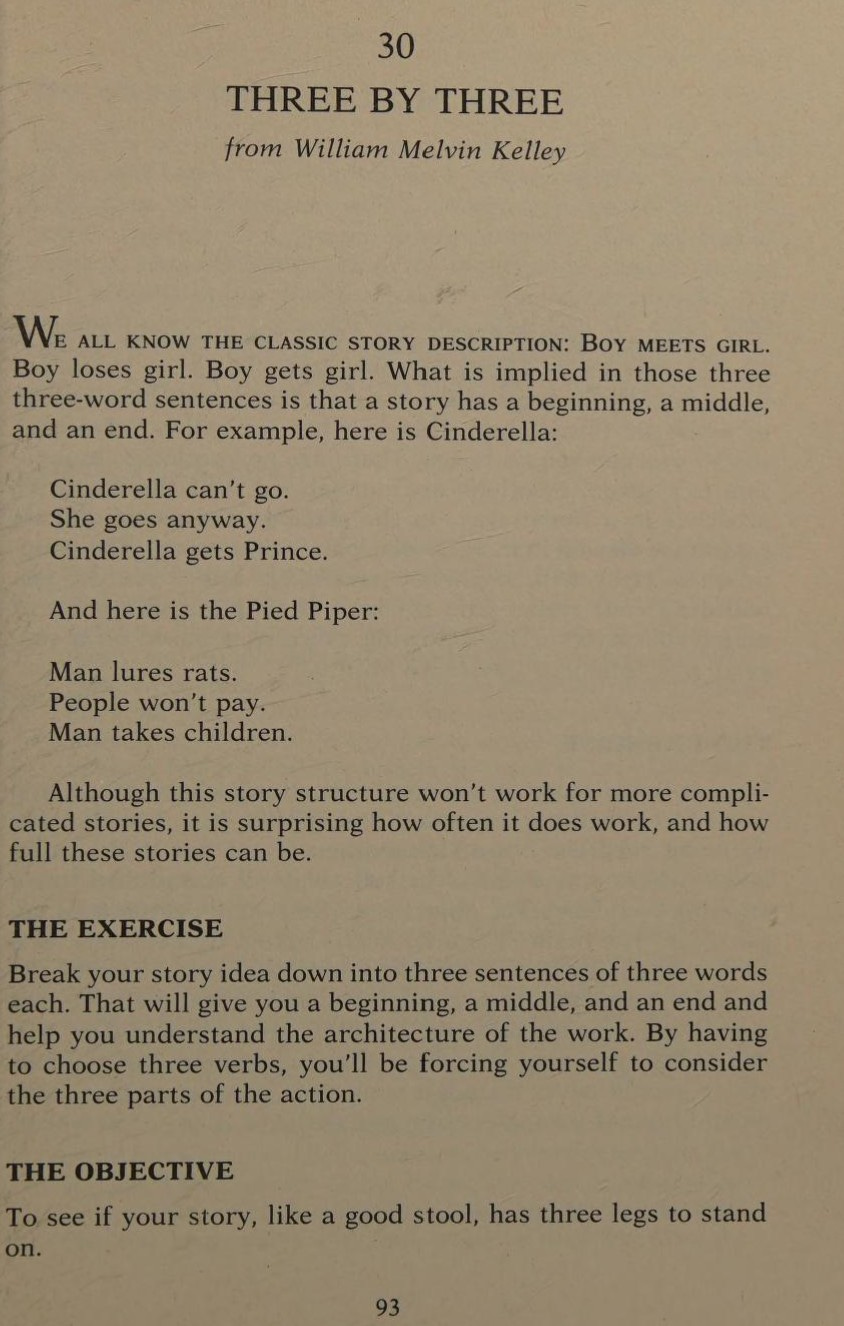
Ryder brilliantly takes Kelley’s “Three by Three” and creates a Literary 3x3 index card activity for his AP English Literature and Composition students. After reading Mary Shelley’s Frankenstein, he has his students use powerful, active language to summarize the novel, identify the central themes of the story, and create decks of index cards to use in collaborating with others while analyzing the text. Ryder explains:
[Students] find themselves equipped with a powerful analytical tool and dynamic synthesis process that evolve[s] throughout the school year. They [are] able to distill a text down to its most essential concepts and themes, identify the benefits and challenges of collaborative analysis, and recognize trends across a collection of analyses.
Pizza might get books in my students’ hands, but I want them to have a rigorous literary experience like Ryder’s AP Literature and Composition students. I wanted an independent reading challenge that would keep them reading for the rest of the year.
I presented Literary 3x3s to my students as a contest. I started by having them guess Disney movies from the Literary 3x3 (L3x3) clues that I gave them. For example, a L3x3 for Beauty and the Beast might read:
Arrogance transforms handsomeness
Mistake creates captivity
Inner beauty conquers
Notice how a strong verb anchors the nouns in each line. Not only do these nine words summarize the story, they hint at possible themes for a later literary discussion.
Here is another example from The Little Mermaid where the verb sits squarely in between two nouns.
Curiosity seeks freedom
Silence creates confusion
Love breaks spell
Once my students understood the basic concept, I revealed the challenge: Summarize a story without using specific names or events. Use only 3 lines of 3 words each.
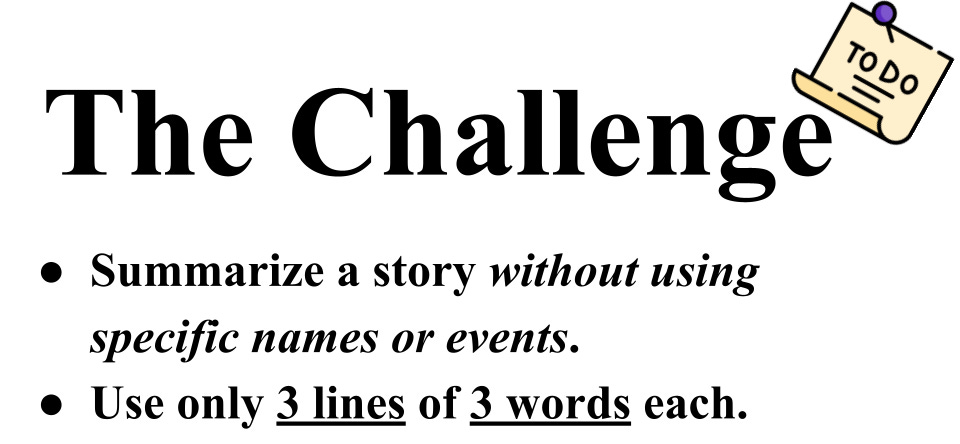
Their L3x3s should use complete sentences, effective word order, and strong verbs and adjectives. I did not allow them to use pronouns, proper nouns (no spoilers!) or to repeat any words. I gave them many examples from movies, which they loved. However, when I gave examples from famous middle-grade novels, (e.g.: The BFG by Roald Dahl, Holes by Louis Sachar, Charlotte’s Web by E.B. White, Tuck Everlasting by Natalie Babbitt, Because of Winn-Dixie by Kate DiCamillo, The Giver by Lois Lowry) they struggled to guess the novel from my Literary 3x3 clues because many had not read any of the books. I was stunned, but resolute in motivating my students to read.
For the past month, every time a student reads a novel, I have them complete a Literary 3x3 for our community bulletin board. They either illustrate the book cover or I print it out in color. To get the board started, I printed a few examples that I shared in class. Some students balked at not being able to read anything online or having to get their novel approved by me. However, many students are now asking for more independent reading time and making more trips to the school library.2
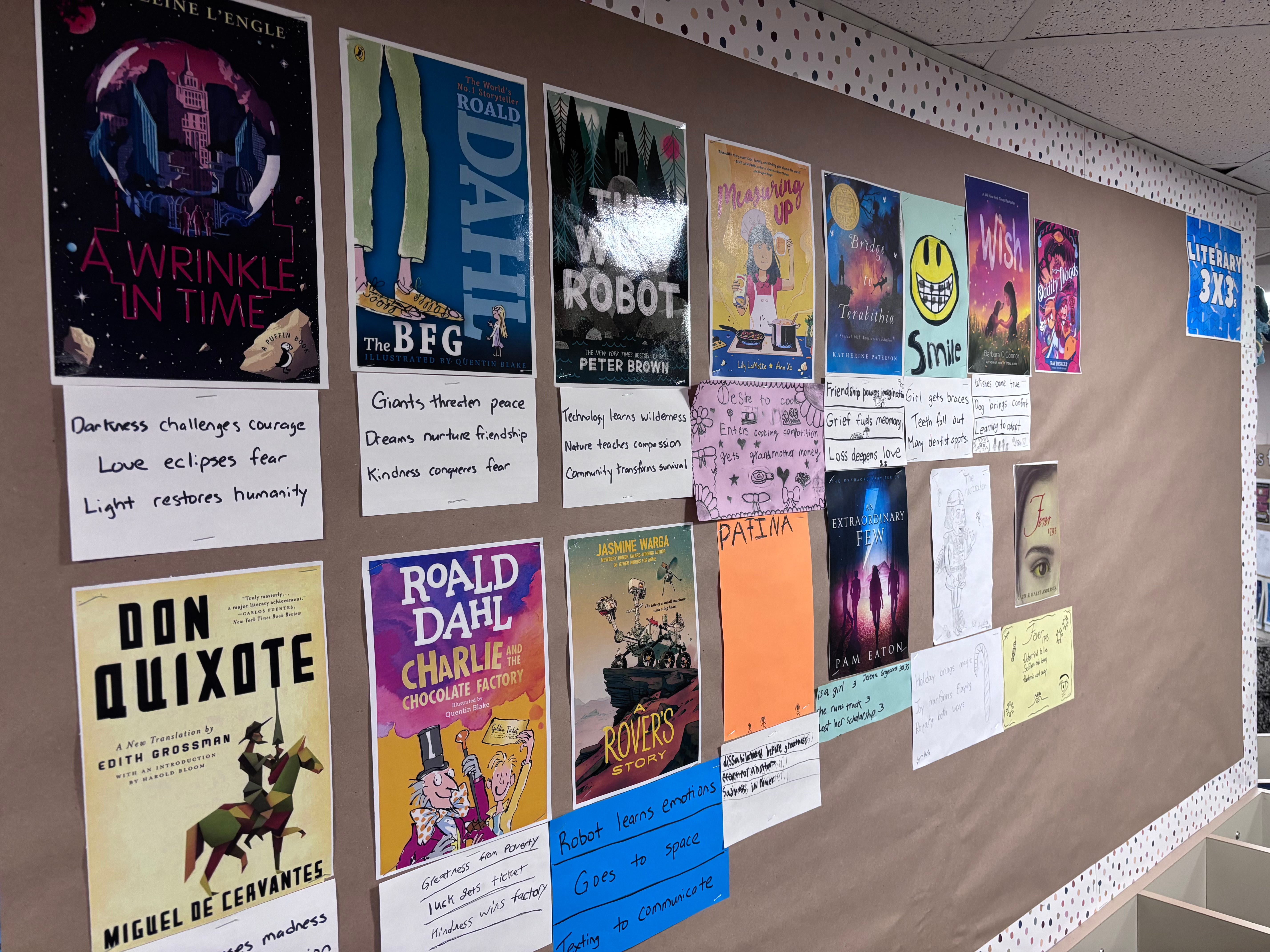
Our board is slowly growing with each book a student reads. The school library may have a paltry selection of novels, but our local public library system visits throughout the school year. They give book talks on new and popular middle-grade novels and have donated a handful of copies for the entire grade-level. A colleague created another community bulletin board for students to sign up for novels they are interested in reading. As soon as a student finishes a book, they cross off their name and give it to the next student on the list. If students do not see anything they like, the library offers a personalized reading recommendation list based on their interests.
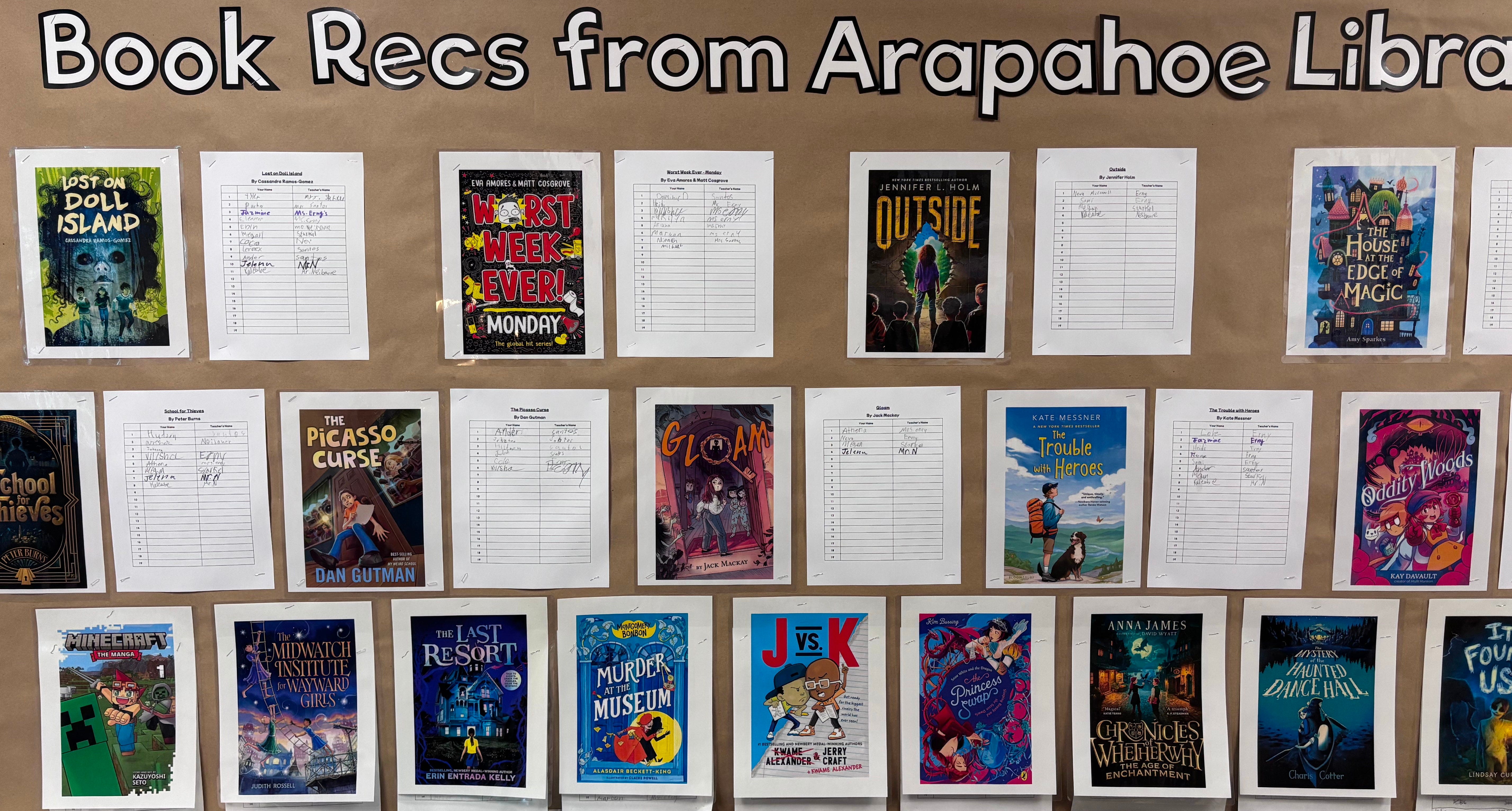
In the spring, I plan to use L3x3s as a literary analysis tool, but for now, it seems to be a great motivator for students to read more novels. Combining L3x3s with the reading certificates I collected from restaurants, gives students an extra incentive to read. When students finish the book, they must complete a L3x3 for the bulletin board before receiving a certificate for free pizza, ice cream, or other treat. I am brazenly bribing my students to read both at school and at home, and it appears to be working!


I am trying to remain patient and stay cautiously optimistic. It is probably going to take many of my most reluctant readers 15-20 attempts with a book before they develop a taste for reading. There is no guarantee that Literary 3x3s and bribery will transform my students into lifelong readers. If this is going to work, I have to create a culture of reading literature in my classroom, sans standardized basal textbooks. Beverly Cleary says, “Children should learn that reading is pleasure, not just something that teachers make you do in school.” Wrapping novels in free pizza and dipping them in ice cream may seem like egregious measures to convince my students that reading is pleasure, but I do not care. My goal is for students to read and read well, by any means necessary.
Resources
Here is a copy of the Literary 3x3 Google Slide Deck I created to introduce the concept to my students. I have included slides with lots of movie and middle-grade novel examples. The movie examples came from my students. Feel free to make a copy, modify, and use with your own students.
10 Cheesy Facts About Pizza Hut's BOOK IT! Program | Mental Floss
Here are some cool facts about the Book It! program. I had no idea that not only does it still exist, Pizza Hut’s Book It program was examined in a research study in the late 90s! Researchers stated, “extrinsic rewards for reading set the conditions where intrinsic motivation for reading may develop.” Maybe more restaurants should partner with schools to offer extrinsic rewards for reading.
100 of the Greatest Posters of Celebrities Urging You to Read
How many of these posters do you remember from your middle or high school?
Here is a blast from the past! In this video, RetroDaze discusses the Scholastic Book Fairs of the 80s and 90s. Remember those Rainbow pens where you could change the color of ink just by pressing down on the little plastic tab?
I was so excited to hear that Reading Rainbow is back! When I was a kid, I either watched Reading Rainbow or CBS StoryBreak episodes.
During the pandemic, I loved watching Mychal the Librarian’s videos and was thrilled to learn that he is now hosting the new Reading Rainbow series. If anyone is going to carry on Levar Burton’s legacy, it is Mychal Threets!
Book Tastings are another great way to create a culture of reading with students. In this video, and accompanying article, Edutopia provides some good resources for implementing a Book Tasting in your classroom. You can also read about this teacher’s experience with Book Tastings with her students.

If you haven’t taken advantage of Julie, Books for Kids, you are missing out. Julie is a veteran teacher who does an excellent job recommending book for students, ages 8-12. I have reached out to her multiple times for help finding books for my fifth graders, and she always finds the perfect book for my picky readers.

Another educator I admire is Clarkie Doster from her Substack Book Party. Doster is a former middle school english teacher. I love how she throws book parties for her kids and writes about creating a culture of reading in her family.
I discovered that Pizza Hut’s Book It! program is still going! Unfortunately, I missed the window to enroll my class, but I will definitely sign up next school year.
I am not allowing students to use ebooks for their Literary 3x3s. Physical books only!
I love the 3×3 exercise and may borrow it to encourage reading, and stoke the interests of others with a bulletin board full of reviews. Thank you for sharing. Also: Levar Burton's Reading Rainbow was The Best. Decades later, I can still sing the jingle from it.
I love the idea of 3X3! I'll add that to my book tasting (sometimes I call it book speed dating) lessons on WWII books.