
Thaumaturgy
Transforming a storage room into a classroom


“Looky here, Mr. Beamish,” said Mr. Fotheringay, “Let us clearly understand what a miracle is. It’s something contrariwise to the course of nature done by power of Will....”
H.G. Wells, The Man Who Could Work Miracles
I performed a small miracle in three weeks. In July, I unlocked the door to my new mobile classroom and saw what I would be working with. The fact that it needed to be emptied of storage from the main school building was unsurprising. The size, however, was unexpected. My early roster showed twenty-eight students; I had three weeks to figure out how to fit those fifth-grade bodies into this small storage space.


I could not, as renowned educator Steven Levy suggested thirty years ago in Starting from Scratch, have students arrive on the first day of school to an empty classroom and discuss each and every element to be placed in the classroom. Instead, I decided to design a space where students would feel welcome and excited to come to school.
I have taught in mobile classrooms before. In many ways, teaching “out in the mobiles” is empowering. You do not feel as micromanaged when you are removed from the main school building, and often, you can make more noise than inside. However, the drawbacks are clear: isolation and classroom construction quality. Mobile classrooms (even brand new ones) are shoddy. They are built quickly and made from poor quality materials. Once built, mobiles often sit on campuses for years, serving as extra offices, storage spaces, and temporary classrooms. It is not ideal.
Being a professional educator, you learn to make the best of any and all situations. So, once emptied, I measured and sketched out the classroom’s floorplan. The size of the room was the most immediate challenge. This modular unit consisted of two separate rooms. The district built a dividing wall between the classrooms, removing about five feet of space. I was left with an odd-shaped, aged room, with hopper windows, a popcorn ceiling, and wood paneling. It reminded me of my 90s childhood basement.
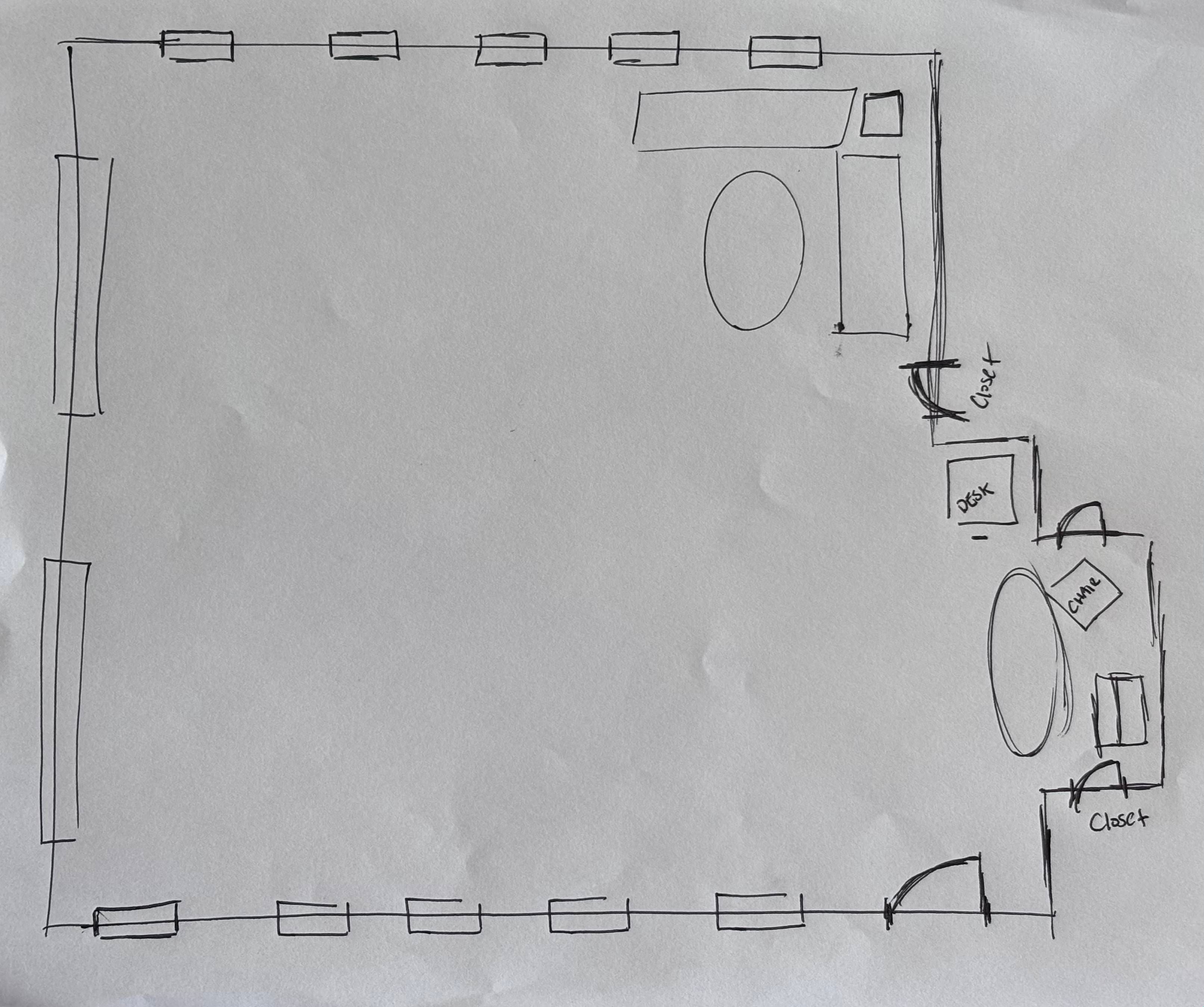
If I only had fifteen students, the size of the space would not be much of a problem. Fitting 30 student desks in this room proved unreasonable. Yes, they fit, end-to-end, wall-to-wall, in rows, leaving no space to circulate the classroom, but if a student needed my help, I could only get to them by Pac-Man moving around a line of desks.
I have never been a fan of students sitting in rows, all facing the front of the room. I realize that there is much value in (and research supporting) assigned rows of individual desks facing the teacher.1 I have experimented with desk clusters of students facing each other, a single horseshoe desk arrangement, a double horseshoe arrangement, L-shaped clusters, concentric circles, and students sitting in rows.

My preferred arrangement is a collection of circular tables, sitting three-five students. I acknowledge that I sacrifice some student engagement for a more intimate, community-focused ambiance, but that is by design. I intend for my students to speak to each other more than they speak to me. Sitting at a circular table, students can easily see who they are speaking to without turning their heads. Round tables flatten classroom hierarchies and elicit a more comfortable learning environment. Since my pedagogy favors dialogic teaching practices, I intentionally design for conversational safe spaces for my students. I want to enhance academic conversations in groups, even if this means some of those conversations are off task. We spend over 180 days together during the year, and I want that time to be in community and fellowship. Not only do circular tables (and dialogic teaching) help restore the humanity that is eliminated in the name of classroom and pedagogical standardization, outfitting a classroom with circular tables improves room traffic and maximizes small spaces. This mobile classroom is such a small space, round tables was the obvious choice.


The district gave me three small tables. I spent the latter weeks of summer looking for circular tables at garage and estate sales in my neighborhood and surrounding area. I secured three more tables for free, giving me enough comfortable seating for twenty-four students.2 I was set to have twenty-eight students, so I decided to bring in two free couches found last summer and a small, rectangular workbench I inherited from a colleague years ago. While my worn-out workbench is not ideal, the couches compensate, giving students flexible seating areas to read or work in small groups.


Providing students with flexible seating and managing them at round tables requires ground rules. On the first day of school, many students are shocked to discover the apparent freedom of their new fifth-grade classroom. They are accustomed to individual desks and minimal movement throughout the school day. During the first week of school, we spend time learning how to learn in our new environment. I teach students how to listen patiently, actively, and the importance of monitoring our voices. When I am giving directions or direct instruction, I expect all students to be at their “home base.” This way, students know that when they are in their assigned seats, they must attune to the teacher, speaker, or whole class. It is rare for me to stand and teach at the front of the room. Instead, I circulate throughout, helping students or calling their attention to a visual aid, video, or student example. This mobile is the smallest classroom space I have taught in, so I expect to bump into or trip over chairs.


My favorite part of this new classroom design is our Tolle Lege library. In June, I was inspired by Ruth Gaskovski to rebuild our classroom library. Using her Reading Rebellion Masterlist, I solicited classic literature book donations that would stretch my students’ vocabularies, patience, and imaginations. During the school year, I will ask parents to donate more books from my book registry in hopes of filling these shelves.
A proper name tells you much about the origin of a place and the intentionality of a space. This special classroom library needs a special name that communicates to students the importance of literacy and literature. As Joel J Miller writes in The Idea Machine, “For all of their impermanence, [books] remain among the most permanent of intellectual deposits a culture can make.” A classroom library should reflect this earnestness. In The Idea Machine, Miller relates a pivotal scene from The Confessions when Augustine retreats to his garden gripping a book. He hears the “singsong voice of a child waft over the garden wall” commanding: Tolle lege, “Take and read.” Opening his book, he finds a passage that soothes his soul. I find this an appropriate name for a classroom library that celebrates reading, writing, and contemplation.


Thaumaturgy
thaumaturge (n.)
“wonder-worker,” 1715, thaumaturg, from Medieval Latin thaumaturgus, from Greek thaumatourgos “wonder-working; conjurer.” This is a compound from -ourgia “a working” (from ergon “work;” from PIE root *werg- “to do”) + thauma (genitive thaumatos) “wonder, astonishment; wondrous thing,” literally “a thing to look at,” from root of theater. Related: Thaumaturgist (1829); thaumaturgic; thaumaturgical (1620s); thaumaturgy (1727) “wonder-working, act of performing something marvelous,” from Greek thaumatourgia, from thaumatourgos.
For the last three weeks, this classroom has been my own. I dreamed about it and sweat over it and busted my back, and soon, a new batch of students will enter my mobile classroom and the possession will shift from the individual to the collective. This space will become ours. We will work and learn and laugh together. There will be days when we make mistakes and grow from them. We will have celebrations and condolences; accountability and responsibility. Soon, I will tour students around our new learning environment, teaching them its short history and the importance of this shared space. Teaching and learning are human endeavors, and though it took a series of small miracles to transform this storage room into a classroom, I am no magician; just a teacher who cares for his students and is excited for another school year.
“This is the beginning - from ‘I to ‘We’. If you who own the things people must have could understand this, you might preserve yourself. But you cannot know. For the quality of owning freezes you forever into ‘I’, and cuts you off forever from the ‘we’.”
John Steinbeck, The Grapes of Wrath
Have a great week!
— Adrian
Resources
This video by EL Education, celebrates the work of longtime educator, Steven Levy. Levy was discussing Project Based Learning and student-built curriculum pedagogy long before they were trendy buzzwords. Known for always “looking for the genius in his students”, Levy has been a tireless advocate for student agency.
In this video, Carnegie Mellon's Anna V. Fisher, Karrie E. Godwin and Howard Seltman discuss how classroom displays affect students’ abilities to maintain focus during instruction. In their study, they found that children in highly decorated classrooms were more distracted, spent more time off-task and demonstrated smaller learning gains than when the decorations were removed.
If you have a class size of more than 30 students, I highly recommend an L-shaped seating arrangement. In this Edutopia video, retired teacher, Jay Schauer, explains how he prefers this arrangement because it reduces the number of students between him and others. Shauer has also written articles about L-shaped desk arrangements in, A Desk Layout Alternative to Rows and Circles, along with a follow-up specifically on his ideas about intentional groupings in A Strategic Approach to Seating Arrangements in High School. He also appeared on Edutopia’s School of Practice podcast episode, A Flexible Seating Arrangement That Teachers Love.

In fifth grade, I alternate between assigned seats and students choosing their own seats. I believe it helps them develop their accountable freedom skills and creates healthy teacherly authority. However, in this piece, Marcus Luther, makes an excellent case for assigned seating on the first day of school.
How Flexible Seating Can Boost Classroom Engagement | NEA Today
Two teachers discuss how flexible seating in their classrooms reduced the amount of negative behaviors and actually limited students’ distractibility.
Teaching: Just Like Performing Magic | The Atlantic
Penn & Teller are my favorite magicians. In this article, Jessica Lahey interviews Teller (who taught Latin before becoming a full-time magician) about magic, entrancing an audience, and intentionally causing confusion. He discusses how performance and discomfort make education can come alive; command, engagement, and passion are all vital to both magic and effective teaching.
There is also a lot of research on how overly-decorated classrooms distract students and harm their ability to focus in class. Again, in my experience, I am not looking to design a space where students are rigidly focused on me all day long. My students might be distracted by the amount of posters I hang on the walls or be overstimulated by our “visually enriched environment” (I have quiet spaces in the classroom), but I would rather my students feel cared for than 100% engaged in a cold, beige classroom.
Unfortunately, I could not procure enough round tables, so I took the rounded square tables provided by the district with gratitude.
Your classroom looks amazing! I generally loved being in a portable except for when the lawnmower came by and made it impossible for students to hear anything. Hopefully that won't happen to you!
Wow! Adrian you performed a miracle. That room looks amazing and that reading nook looks heavenly. Your students are so lucky to have such a thoughtful educator who really cares about them. I look forward to hearing all about your read alouds and new experiences in your classroom. I commend the fact that you have set up the room the way you feel comfortable with it. You clearly put a lot of thought into the research of seating arrangements, and in the end you did what was right for you and your teaching style.